New California Laws Take Effect on Healthcare, Labor, AI and Education
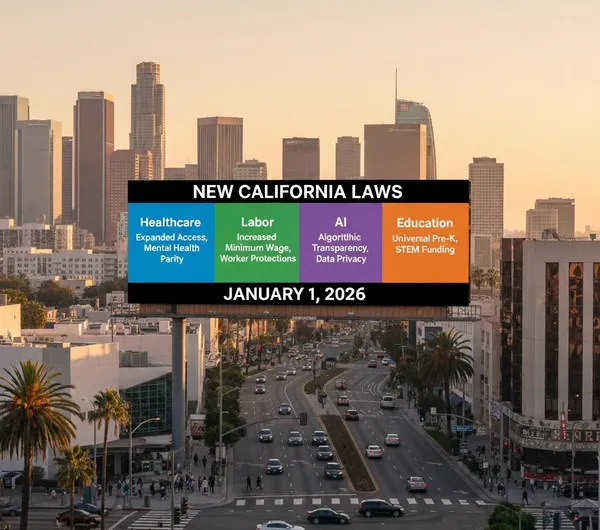
New Laws Begin in California at Start of New Year
In Sacramento, a broad set of California state laws signed in 2024 and 2025 are taking effect, most beginning on January 1, and will influence healthcare, consumer protections, labor rules, technology, education and housing across the state.
Healthcare Costs, Privacy and Immigrant Protections
Gov. Gavin Newsom signed nearly 800 bills in 2024, including measures affecting medical costs and healthcare privacy. Under Senate Bill 40, large group health plans must cap patients’ out-of-pocket insulin costs at $35 for a 30-day supply. Beginning January 1, California will sell $11 insulin pens through the state’s CalRx prescription program.
Large employer health plans will be required to cover infertility treatments, including in vitro fertilization, for all enrollees regardless of marital status, gender identity or sexual orientation, under Senate Bill 729. Implementation of SB 729 has been delayed until 2026 following a push by Newsom.
Assembly Bill 82 allows healthcare providers and employees affiliated with gender-affirming services to request that their residential addresses be withheld from certain public records if they are experiencing harassment or violent threats related to their work. These applications are filed with the California Secretary of State.
Senate Bill 81 prohibits healthcare officials from disclosing a patient’s immigration status or birthplace and from granting immigration authorities access to nonpublic hospital or clinic areas without a search warrant or court order.
Law Enforcement Identification and Legal Rights Changes
Senate Bills 805 and 627 require law enforcement officers in California to visibly display a name or badge number during operations and ban the wearing of masks that conceal their identities while on duty, with limited exceptions. The U.S. Department of Justice has sued California, asserting the laws are unconstitutional and could endanger officers.
Assembly Bill 250 opens a two-year window, from January 1 through December 31, 2027, for adults to file sexual assault claims against private employers or institutions that allegedly engaged in a cover-up, even if those claims were previously barred by the statute of limitations. AB 250 applies to people assaulted after age 18.
Under Senate Bill 1427, California couples may now file a joint petition for dissolution of marriage or legal separation regardless of marriage length or asset level, expanding joint filing beyond the previously limited circumstances.
Consumer and Financial Protections
Senate Bill 1053 bans plastic bags at grocery store checkout stands statewide. Stores may instead offer recycled paper bags or allow customers to bring their own bags. The law was passed in 2024 and is now taking effect.
Assembly Bill 578 requires food delivery services such as Uber Eats, DoorDash and Postmates to provide full refunds when orders are not delivered or are delivered incorrectly. The law also obligates these services to offer human-staffed customer support for handling refund requests.
Under Assembly Bill 1374, rental car companies must give customers a good-faith estimate of total charges, including taxes and fees, when quoting a reservation price, and must disclose whether a vehicle is gas-powered, electric, or uses another fuel source.
Senate Bill 576 bars video streaming services from running advertisements that are louder than the programming they accompany.
Senate Bill 1075 caps overdraft fees at state-chartered credit unions at the lower of $14 or the maximum set by the federal Consumer Financial Protection Bureau.
Labor, Business and Technology Regulations
California’s statewide minimum wage rises from $16.50 to $16.90 on January 1. Workers who are paid below the minimum wage can file a wage theft claim with the California Labor Commissioner, and state labor laws apply regardless of a worker’s immigration status.
Assembly Bill 268 adds Diwali to California’s official list of statewide holidays, permitting public schools to close and allowing state employees to take the holiday off.
Assembly Bill 656 requires major social media platforms to provide an account deletion button in user settings that is accessible on phones, computers and tablets, and to delete stored personal information when a user cancels an account.
Senate Bill 243 obligates artificial intelligence companies to notify users younger than 18 at least every three hours that they should take a break and that the chatbot is not human. The law also requires reasonable measures to prevent companion chatbots from generating sexually explicit content and to prevent the production of suicide or self-harm content, including referring users to crisis support resources.
Senate Bill 53 requires large AI companies to publicly disclose safety and security protocols and risk evaluations and to report critical safety incidents, such as cyberattacks or unsafe autonomous AI behavior, to the California Office of Emergency Services. Violations can result in civil penalties of up to $1 million.
Assembly Bill 671 streamlines approval processes for independent restaurants seeking to retrofit spaces.
Assembly Bill 1340 permits ride-hail drivers working for companies such as Lyft and Uber to unionize and bargain collectively while remaining classified as independent contractors. The law was crafted as a compromise between labor organizations and gig economy firms.
Senate Bill 237 authorizes up to 2,000 new oil wells annually in Kern County through 2036 to allow increased oil production in Central California.
Education, School Safety and Civil Rights
Senate Bill 640 provides automatic admission to one of 16 California State University campuses for public high school students who meet CSU’s minimum eligibility requirements.
Senate Bill 760 mandates that all California public schools provide at least one all-gender bathroom beginning July 1. The law builds on existing requirements allowing students to use bathrooms aligning with their gender identity.
Assembly Bill 3216 requires public schools to adopt policies by July 1 that prohibit or limit student smartphone use on campus, leaving specific restrictions to local school decisions while mandating some level of limitation.
Assembly Bill 49 bars federal immigration agents from entering nonpublic areas of public schools without a judicial warrant or court order and prohibits school districts from sharing information about students, their families, teachers and school staff with immigration authorities absent such a warrant. Senate Bill 98 requires school administrators to notify families and students if federal agents conduct immigration operations on K-12 or college campuses.
Assembly Bill 715 creates a state Office for Civil Rights to address antisemitism and other forms of discrimination in California schools. A federal judge in San José has rejected a lawsuit challenging AB 715, allowing the law to take effect.
Animal Protection and Environmental Review Changes
Senate Bill 765 designates the giant garter snake as the official snake of California. The species lives in the Central Valley and has experienced habitat loss due to urban and agricultural development.
Assembly Bill 867 makes it illegal to declaw cats in California unless the procedure is medically necessary. The law defines declawing as amputating the first bone of each toe or severing the tendons.
Under new provisions tied to Assembly Bill 130 and Senate Bill 131, various infrastructure projects are exempted from review under the California Environmental Quality Act, in an effort to accelerate construction timelines and reduce costs.
Housing and Tenant Requirements
Assembly Bill 628 requires landlords entering into new leases to provide tenants with working stoves and refrigerators. Landlords must replace these appliances within 30 days if a manufacturer issues a recall. The measure expands existing requirements that residential buildings maintain adequate heating and hot water.
📰 Related Stories
- Sacramento PFAS Pesticide Tracking Bill Sent to Gov. Newsom Sacramento • Aug 28, 2026
- Sacramento Wildfire Liability Plan Puts California Utilities, Insurers and Survivors at Odds Sacramento • Aug 25, 2026
- California Senate Committee Rejects Controversial Animal Protection Bill Amid Election-Year Politics Sacramento • Aug 14, 2026
- Chicago Communities Push Back Against Proposed White Sox Stadium Move to South Loop Chicago • Sep 09, 2026