Mexican Military Operation Kills Cartel Leader ‘El Mencho,’ Triggers Violence and Travel Disruptions
Cartel Leader Killed in Jalisco Operation on February 22, 2026
Mexico's most-wanted drug lord, Nemesio Rubén Oseguera Cervantes, known as "El Mencho," was killed by the Mexican military on Sunday, February 22, 2026, in the state of Jalisco. The operation took place in the mountain town of Tapalpa, approximately two hours southwest of Guadalajara. Oseguera Cervantes, aged 59, led the Jalisco New Generation Cartel (CJNG).
Mexican army special forces conducted the operation in Tapalpa. During the mission, CJNG members attacked the troops. Military forces returned fire, killing four cartel members at the scene. Oseguera Cervantes was wounded and was being transported by aircraft to Mexico City when he died. Three cartel members in total died during transfer, and two others were arrested. Three members of the armed forces were wounded. The military seized armored vehicles, rocket launchers, and other weapons during the operation.
International Intelligence Support and Official Confirmation
Mexico's Defense Secretariat confirmed that the operation was carried out with complementary intelligence provided by United States authorities. White House Press Secretary Karoline Leavitt stated that the United States provided intelligence support for the mission.
The CJNG, which Oseguera Cervantes co-founded around 2007–2009, is considered by the FBI and DEA to be Mexico's most powerful trafficking organization and is described as responsible for the bulk of cocaine, methamphetamine, heroin, and fentanyl entering the United States. Oseguera Cervantes was regarded as the most prominent Mexican drug lord still at large following the captures of Joaquín "El Chapo" Guzmán and Ismael "El Mayo" Zambada, who are in U.S. custody.
Retaliatory Violence Across Multiple Mexican States
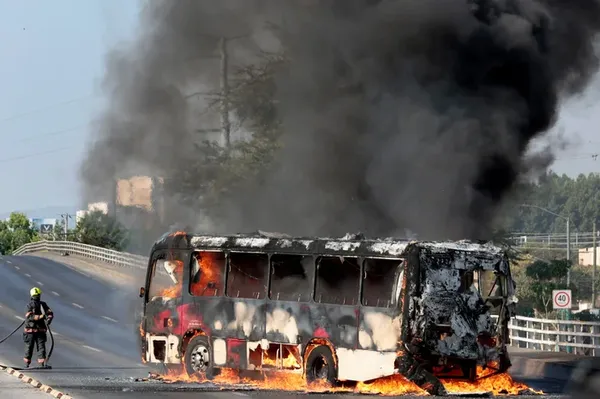
Within hours of the military operation in Tapalpa, suspected CJNG members launched coordinated acts of retaliatory violence across Mexico. Armed groups torched vehicles, blocked highways with burning buses and trucks, and clashed with security forces across at least eight states: Jalisco, Michoacán, Guanajuato, Colima, Nayarit, Tamaulipas, Querétaro, and Zacatecas.
In Guadalajara, Jalisco’s capital, activity was severely reduced on Sunday night. Smoke rose over Puerto Vallarta as burning vehicles obstructed roads near the tourist resort. Videos showed passengers running through the Guadalajara airport. Jalisco Governor Pablo Lemus declared a Code Red for the state, suspended public transportation, and urged residents to remain at home. The Code Red extends into Monday, February 23, with schools and public transit closed in Jalisco. By Sunday evening, Mexico’s Defense Secretariat reported that 17 of 21 narco-blockades in Jalisco had been cleared.
Flight Cancellations Affect Portland and Other Routes
The violence in Mexico caused disruptions to air travel. At Portland International Airport (PDX) in Oregon, two incoming flights from Mexico were canceled on Sunday. Alaska Airlines Flight 1445 from Puerto Vallarta, scheduled to arrive at 8:10 PM ET, and Volaris Flight 1870 from Guadalajara, scheduled to arrive at 8:55 PM ET, did not operate. A Volaris departure from Portland to Guadalajara at 11:18 PM was also canceled. Flights between Portland and Mexico were reported as remaining on schedule for Monday, February 23, with the situation described as fluid.
U.S. State Department Shelter-in-Place Warnings
The U.S. State Department expanded shelter-in-place warnings for American citizens in response to the unrest. U.S. nationals in Jalisco, including Puerto Vallarta, Chapala, and Guadalajara; Baja California, including Tijuana, Tecate, and Ensenada; Quintana Roo, including Cancún, Cozumel, Playa del Carmen, and Tulum; and portions of Guanajuato, Guerrero, Michoacán, Oaxaca, Nuevo León, and Tamaulipas were urged to stay indoors, avoid law enforcement activity, minimize movement, and monitor local media.
The State Department already had a Level 2 "Exercise Increased Caution" advisory for Mexico, in place since August 2025. Level 4 "Do Not Travel" advisories remain in effect for Colima, Guerrero, Sinaloa, Tamaulipas, and Zacatecas.
Government Response and Ongoing Security Concerns
Mexican President Claudia Sheinbaum urged calm and credited the armed forces for their role in the operation. She stated that coordination between federal and state governments remains absolute. The city of Guadalajara is scheduled to host four matches in the 2026 FIFA World Cup later in the summer. Mexico City’s Benito Juárez International Airport and airports in Cancún and other states not directly affected by the violence were reported to be operating normally.
📰 Related Stories
- Dashcam Captures Green Fireball Meteor Over Pacific Northwest Portland • Mar 25, 2026
- Vibra Healthcare to Close Portland Long-Term Acute Care Hospital Portland • Dec 02, 2025
- Forest Grove Quintuple Homicide Investigation Identifies Five Victims Forest Grove • Aug 25, 2026
- San Antonio Enacts $4.4 Billion FY 2027 Budget Expanding Housing to $37.7 Million as VIA Green Line Rapid Transit Progresses San Antonio • Sep 30, 2026