Crosby’s Opera House Identified as Chicago’s First Modern Art Gallery
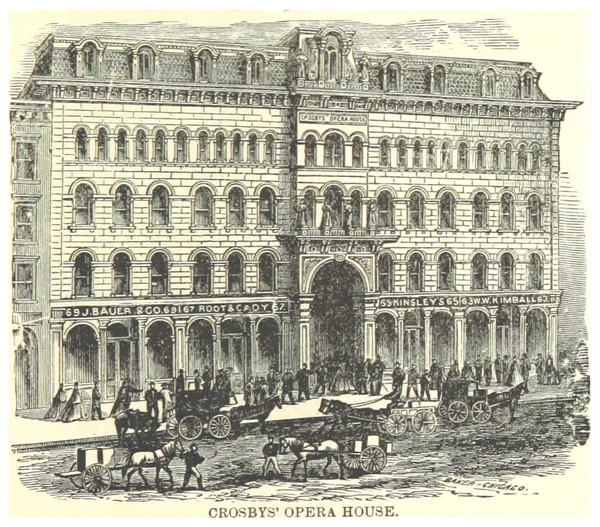
As of March 25, 2026, historians tracing the origins of visual exhibition in the city conclude that Crosby’s Opera House — opened in 1865 — represents Chicago’s first modern commercial art gallery. The assessment reframes what “Chicago’s first art gallery” means by distinguishing early photographic studios and exclusive exhibition rooms from a purpose-built public gallery attached to a major cultural venue.
In the mid-19th century, Chicago evolved from a trading post to an industrial center where lumber, rail and stockyards dominated public identity. Early display spaces included photographers’ studios — among them those run by figures such as Alexander Hesler and others who showcased portraits, panoramas and paintings as early as 1849 — and privately run sale rooms that charged admission. Researchers note these venues were often geared toward affluent patrons. Crosby’s Opera House combined an expansive gallery with theatrical programming, featuring high ceilings, a skylight and brief free classes for artists; scholars say the institution established a new model for public art presentation in the city until it was destroyed in the 1871 Great Chicago Fire.
After the fire, artists reorganized: the Chicago Academy of Fine Arts (founded in 1879) grew into the School of the Art Institute of Chicago and signaled a more democratic, artist-led direction. The city’s early galleries, fair displays and later clubs reflect patterns of exclusion by race, class and gender, while alternative institutions and artist organizations gradually broadened opportunities for Indigenous, Black, immigrant and women creators to exhibit and teach.
📰 Related Stories
- Chicago Debuts First LaSalle Street Office-to-Housing Conversion at Bellwether as City Expands Divvy Bike-Share Network Chicago • Sep 30, 2026
- Chicago Advances Historic $5.7 Billion CTA Red Line Extension as Walsh-VINCI Joint Venture Drills Foundations for Four Far South Side Stations Chicago • Sep 30, 2026
- Chicago Introduces 12-Month Data Center Moratorium Ordinance as CTA Reports 27.9% Drop in Transit Crime Chicago • Sep 30, 2026
- San Diego MTS Enacts $482.5 Million Operating Budget and October 1 Fare Update as Station-Area Housing Expands San Diego • Sep 30, 2026