Phoenix Expands Water-Security Strategy With New Recycling Pilot and Desert Research Hub
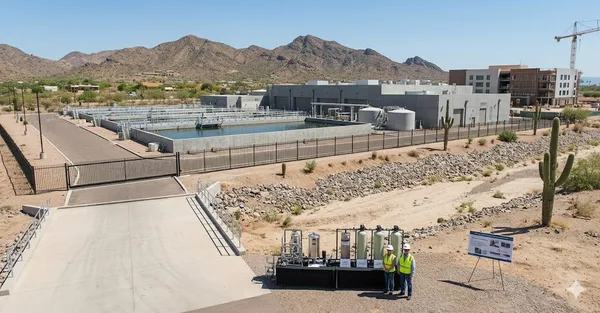
Phoenix Advances New Water-Security Blueprint
As pressure mounts on the Colorado River and regional groundwater supplies, Phoenix officials have unveiled a broadened water-security strategy that includes a new wastewater recycling pilot program, investment in desert-focused research facilities, and a citywide campaign encouraging businesses to adopt advanced conservation technologies. The initiative aims to prepare Phoenix for long-term population growth while reducing dependence on overstressed river systems.
A City Growing Faster Than Its Water Supply
Phoenix remains one of the fastest-growing major cities in the United States, adding thousands of new residents annually as companies relocate to the metro area. City planners say that without proactive measures, demand for residential, industrial, and agricultural water-use could outpace available supply within the next decade. Officials stressed that the updated strategy is not a response to immediate crisis but a preemptive effort to secure the city's long-term water resilience.
Over the last several years, federal and state agencies have raised alarms over declining Colorado River reservoirs, which supply a significant share of Phoenix's water portfolio. Although recent agreements have temporarily stabilized allocations, experts warn the region must adapt to a hotter, drier climate driven by accelerated evaporation and reduced snowpack.
New Water-Recycling Pilot Targets Industrial Users
The centerpiece of Phoenix's plan is a new industrial wastewater recycling pilot. The program will allow large facilities—such as semiconductor plants, distribution centers, and manufacturing sites—to treat and reuse water multiple times before it leaves their systems. City officials project that widespread adoption could reduce industrial freshwater demand by as much as 20% in the coming years.
Unlike residential conservation campaigns, which rely heavily on community outreach, the pilot will test real-time digital monitoring, automated filtration controls, and closed-loop reuse systems. Participating companies will receive incentives to retrofit existing infrastructure, and the collected data will guide future policy decisions.
Desert Water Innovation Hub to Support Research and Testing
Alongside the recycling pilot, Phoenix is launching a Desert Water Innovation Hub—an applied research center focused on drought modeling, adaptive irrigation, high-efficiency cooling systems, and atmospheric water-harvesting technologies. The hub will operate in partnership with Arizona State University and regional utilities, giving researchers a testbed to deploy new technologies directly in desert conditions.
City leaders say the hub will also help accelerate the commercialization of water-saving products, creating a stronger local economic ecosystem around sustainability and cleantech.
Neighborhood Grants Encourage Yard Conversions
To support residential conservation, Phoenix will expand its landscape conversion grants, offering households incentives to replace high-water grass lawns with desert-adapted plants. The new program includes a digital planning tool that estimates water savings based on plant selection, shading, and soil type—features designed to make the program more accessible to homeowners unfamiliar with xeriscaping.
Early projections suggest widespread adoption could save tens of millions of gallons annually. The city notes that single-family homes remain one of the largest contributors to non-essential water use, making residential participation critical to long-term sustainability.
Residents Divided but Engaged
Public response to the expanded plan has been mixed. Many residents welcome long-term investments in water security, particularly after several years of extreme heat and drought. Others express concern about the cost of infrastructure upgrades and potential impacts on future development. City officials have emphasized that the strategy relies on phased implementation, minimizing rate increases and offering incentives to early adopters.
Despite differing opinions, community participation in forums and consultations has risen significantly, suggesting the issue resonates across economic and demographic groups.
Looking Ahead: Preparing for a Hotter, Drier Future
Phoenix leaders say the expanded water-security strategy positions the city as a model for desert urban planning. Officials stress that while short-term river allocations have stabilized, long-term climate trends demand sustained innovation and policy coordination across states, utilities, and industries.
If successful, the strategy may demonstrate how fast-growing cities in arid regions can continue to expand while reducing pressure on fragile ecosystems—and ensure that Phoenix remains livable in the face of rising temperatures and shifting water realities.
Reference Links (Context Sources)
- City of Phoenix Water Services Department: https://www.phoenix.gov/waterservices
- Arizona State University – Water Research & Sustainability: https://sustainability.asu.edu/
- Colorado River Collaborative Reports: https://www.usbr.gov/lc/region/programs/crbstudy.html
- Arizona Department of Water Resources: https://new.azwater.gov/
📰 Related Stories
- North Phoenix Accelerates Development of 2,300-Acre Halo Vista Mega-District Adjacent to Expanding TSMC Semiconductor Hub Phoenix • Sep 28, 2026
- TSMC Advances Multi-Billion North Phoenix Semiconductor Complex as Valley Metro Named Top Transit System in North America Phoenix • Sep 26, 2026
- American Airlines Named Primary Anchor Carrier for Sky Harbor's Future West Terminal Under Destination PHX 2050 Phoenix • Sep 26, 2026
- Phoenix Police Headquarters Temporarily Closes Public Service Counters Following Major Water Pipe Rupture Phoenix • Sep 25, 2026