Transport for West Midlands Launches Live Tram Testing on £227 Million Birmingham Eastside Metro Extension to Digbeth
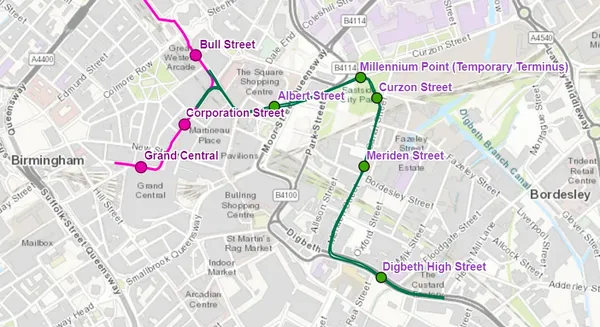
Pioneering Light Rail Artery Connects City Centre to Creative Quarter
BIRMINGHAM, West Midlands — In a monumental operational milestone for urban mobility across the English Midlands, Transport for West Midlands (TfWM), the West Midlands Combined Authority (WMCA), and construction delivery partner Midland Metro Alliance (MMA) have officially commenced live overnight track testing along the first operational phase of the £227 million Birmingham Eastside Metro extension. Trams operated powered runs along the newly laid twin-track alignment between Lower Bull Street, Albert Street, and the landmark terminus adjacent to Millennium Point, bringing rapid light rail transit to the doorstep of the city's historic Eastside innovation district.
Spanning 1.7 kilometres of new street-level track, the extension branches off the existing West Midlands Metro mainline at Bull Street, traversing southward through the knowledge quarter and the revitalized Digbeth industrial corridor. The line establishes direct light-rail connectivity between Grand Central (Birmingham New Street) and the future High Speed 2 (HS2) Curzon Street station interchange, forming an indispensable spine in the region's £1.3 billion transit modernization program.
Bespoke Catenary-Free Battery Traction and Architectural Interchanges
The Birmingham Eastside Metro Extension incorporates four strategically situated passenger stops engineered for seamless multi-modal integration:
- Albert Street Stop: Situated in the retail core, offering direct pedestrian connectivity to Birmingham's central business district and retail boulevards.
- Moor Street Gateway / Curzon Street Interchange: A world-class multimodal transit nexus uniting the Metro directly with Birmingham Moor Street station and the monumental concourse of the future HS2 Curzon Street terminal.
- Millennium Point Stop: Positioned adjacent to Eastside City Park, providing rapid transit access for thousands of students and faculty at Birmingham City University (BCU) and visitors to the Thinktank Science Museum.
- Digbeth Terminus (High Street Deritend): Anchoring Birmingham's renowned creative quarter, linking media studios, independent retail hubs, and the Custard Factory cultural precinct.
Cutting-Edge Battery Power Eliminates Overhead Catenary Wires
A crowning engineering feature of the Eastside extension is its total reliance on catenary-free battery operation. Leveraging the advanced lithium-ion onboard energy storage systems of the fleet’s CAF Urbos 100 light rail vehicles, trams transition seamlessly from overhead wire power to onboard battery traction upon departing the city centre trunk.
Eliminating overhead electrical catenary wires and support poles preserves the sightlines of Birmingham’s historic Victorian brick facades and Curzon Street's architectural heritage. In addition, innovative elastomeric rail boot insulation systems were installed along High Street Deritend to dramatically reduce ground-borne noise and vibration for adjacent residential lofts and recording studios.
Driving Regional Regeneration and Decarbonizing Urban Transport
Civic leaders and transport directors emphasized that the Eastside Metro line is already unlocking over £1 billion in private regeneration, supporting thousands of new energy-efficient homes and creative commercial enterprises across Digbeth.
By providing an attractive, zero-emission mass transit alternative to private automotive traffic on the A4540 Middleway ring road, the extension prevents thousands of daily vehicle journeys, directly advancing Birmingham City Council’s Route to Zero (R2Z) climate blueprint and establishing the West Midlands as a European leader in smart light rail transit.
📰 Related Stories
- HS2 Advances Construction of Net-Zero Curzon Street Station Above Ground in Birmingham's City Centre Birmingham • Oct 17, 2026
- Birmingham Accelerates Landmark Curzon Street HS2 Station as Concrete Piling Concludes and Platform Decks Rise Birmingham • Oct 13, 2026
- Birmingham Advances Landmark £1.7 Billion West Midlands Transport Acceleration and Metro Extension Milestones Birmingham • Oct 13, 2026
- Mayor Tracy Brabin and WYCA Advance Landmark £2.5 Billion West Yorkshire Mass Transit Tram System Linking Leeds and Bradford Leeds • Oct 18, 2026