Hamburg Accelerates Landmark €2.8 Billion Driverless U5 Metro Line with Alstom CBTC Signaling and GoA4 Train Fleet
A Generational Leap for Mass Transit Across Germany's Second-Largest City
HAMBURG, Germany — In a transformative milestone for sustainable urban mobility, transit automation, and regional civil engineering, the Free and Hanseatic City of Hamburg and municipal transit authority Hamburger Hochbahn AG (HOCHBAHN) have reached peak construction and procurement milestones across the landmark €2.8 billion U5 Metro line. Spanning approximately 25 kilometres of newly engineered subterranean heavy rail, the U5 represents Hamburg’s first-ever fully automated, driverless subway line, designed to traverse the Hanseatic metropolis from Bramfeld in the northeast through City Nord and the city center to Volkspark and the Arenas in the west.
The monumental project establishes high-speed rapid rail transit for major commercial districts and densely populated residential quarters that have historically lacked direct subway connections. Once fully completed, the U5 will provide high-capacity, turn-up-and-go mobility for more than 270,000 daily passengers, seamlessly integrating with existing U-Bahn lines (U1, U2, U3) and the S-Bahn suburban network.
Historic Framework Contract for Alstom GoA4 Trains and Urbalis CBTC
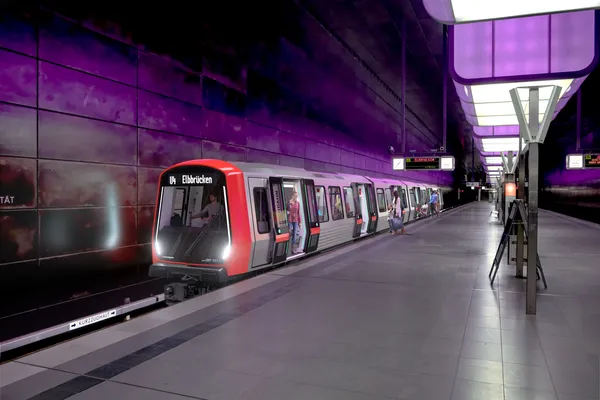
Underpinning the technical prowess of the U5 is a transformative framework agreement signed between HOCHBAHN and global rail manufacturing giant Alstom. Valued at up to €2.8 billion, the contract encompasses the supply of up to 374 next-generation metro cars, including bespoke, fully automated Grade of Automation 4 (GoA4) trainsets specifically engineered for driverless operations on the U5 line, alongside semi-automated units for the legacy network.
The U5 is powered by Alstom's state-of-the-art train-centric Urbalis Communications-Based Train Control (CBTC) signaling system. This cutting-edge digital signaling allows autonomous trains to communicate directly with one another via continuous radio frequency, permitting ultra-tight train headways of just 90 seconds during peak commuting hours. Featuring continuous walk-through articulated gangways, intelligent climate control, USB charging ports, and panoramic front windows that offer passengers a forward-facing view of subterranean tunnels, the trains set a new global benchmark for rider comfort and automated safety.
Low-Carbon Civil Engineering and Barrier-Free Underground Hubs
Physical civil engineering is advancing rapidly along the initial 5.8-kilometre eastern segment linking Bramfeld, Steilshoop, Barmbek-Nord, Sengelmannstraße, and City Nord. Executed by specialized engineering joint ventures including civil contractors Züblin and Wayss & Freytag, construction teams are implementing stringent low-carbon engineering practices, including the use of eco-friendly low-clinker concrete and optimized excavation geometry that curbs structural carbon emissions by up to 70 percent compared to traditional tunneling methods.
At Sengelmannstraße, crews are executing a complex multi-level underground cross-platform transfer interchange that allows passengers to transfer seamlessly between the automated U5 and the existing U1 line with a single step across the platform. All U5 stations are built to strict universal accessibility mandates, incorporating redundant elevators, wide escalators, and full-height glass Platform Screen Doors (PSDs) that synchronize with automated train doors to prevent track incursions while optimizing underground acoustic and thermal comfort.
Foundational Pillar for Hamburg's Statutory Climate Neutrality by 2040
Hamburg’s First Mayor and the Senator for Transport and Mobility Transition emphasized that the U5 Metro functions as the indispensable architectural backbone of the city's 'Hamburg-Takt'—the visionary mobility mandate ensuring that every resident in the city has access to high-frequency public transit within five minutes of their front door.
Operated exclusively with 100 percent renewable green electricity, the driverless U5 will replace an estimated 100,000 private vehicle trips per day, avoiding tens of thousands of tonnes of carbon dioxide emissions annually. By eliminating traffic gridlock, supporting walkable transit-oriented neighborhoods, and connecting university campuses and medical research centers directly to the urban core, the U5 establishes Hamburg as a pioneering global capital of sustainable, autonomous urban transit.
📰 Related Stories
- Hamburger Hochbahn Accelerates €2.8 Billion Driverless U-Bahn Line U5 with Next-Generation Alstom DT6 Train Fleet Hamburg • Oct 06, 2026
- Fraport Completes €4 Billion Terminal 3 at Frankfurt Airport Ahead of Landmark 2026 Commercial Operations Frankfurt • Oct 17, 2026
- Fraport Nears Commissioning of Landmark €4 Billion Frankfurt Airport Terminal 3 and Automated Sky Line People Mover Frankfurt • Oct 13, 2026
- Berlin Marks Topping-Out Milestone on €4.5 Billion Siemensstadt Square Innovation Megaproject and Advances Siemensbahn Rail Reactivation Berlin • Oct 05, 2026