Berlin Marks Topping-Out Milestone on €4.5 Billion Siemensstadt Square Innovation Megaproject and Advances Siemensbahn Rail Reactivation
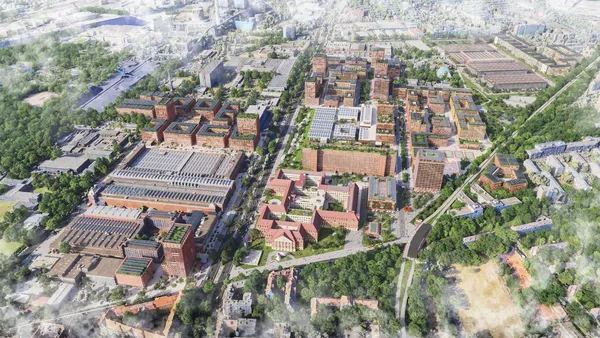
Historic Transformation of an Industrial Heartland into Europe's Smart District
BERLIN, Berlin — In a landmark milestone for European urban innovation and climate-neutral technology, Siemens AG and the Senate of Berlin have celebrated the official topping-out ceremony for the central high-rise and atrium complex at the transformative €4.5 billion Siemensstadt Square megaproject in Berlin-Spandau. Marking the completion of structural framing on the development’s first major building phase, the milestone accelerates the conversion of the historic 76-hectare industrial cradle into one of the world's most advanced, mixed-use smart districts.
Originally founded over a century ago as Siemens’ primary manufacturing base, Siemensstadt Square is being completely reimagined as a zero-carbon innovation campus combining advanced industrial manufacturing, scientific research hubs, public education, and modern residential housing. Under an expanded municipal framework plan approved by the Berlin Senate, the district will now accommodate approximately 3,750 modern apartments—nearly doubling original housing targets—providing affordable, energy-efficient homes for more than 7,000 residents alongside 20,000 technology and engineering jobs.
Architectural Excellence and Europe's Largest Wastewater Heat Energy Grid
The newly topped-out central entrance ensemble, designed by renowned architectural firm Henn, forms the architectural anchor of the district, featuring a sleek 60-metre timber-hybrid office high-rise and an expansive glass-roofed atrium that opens onto the public plaza on Nonnendammallee. The complex will house modern collaborative laboratories, startup incubators, and public civic facilities equipped with dynamic smart-building sensors and digital automation systems.
Setting a global benchmark for urban decarbonization, Siemensstadt Square is delivering Europe’s largest municipal wastewater heat recovery network in partnership with Berliner Wasserbetriebe. Utilizing specialized heat exchangers embedded directly into regional wastewater mains, the system harnesses thermal energy from municipal sewage to provide 100% fossil-fuel-free district heating and cooling. Powered entirely by certified green electricity, the geothermal and wastewater loop will eliminate more than 85 percent of the district’s operational carbon emissions.
Reactivating the Historic Siemensbahn S-Bahn Railway Corridor
Sustainable public mobility forms the central circulatory spine of Siemensstadt Square. Working in close partnership with Deutsche Bahn (DB) and the State of Berlin under the regional i2030 public transit initiative, civil engineering teams are actively progressing the complete reconstruction and reactivation of the historic Siemensbahn S-Bahn rail line.
Decommissioned since 1980, the 4.5-kilometre elevated rail viaduct is being fully modernized with new steel-and-concrete bridge superstructures, noise-dampening ballast mats, and modern electronic signaling. Once reopened by 2029, the line will feature three fully accessible stations—Jungfernheide, Wernerwerk, and Siemensstadt—providing high-frequency, six-minute electric passenger rail connections directly into Berlin’s central Ringbahn network and Berlin Hauptbahnhof.
A Global Blueprint for Digital Urbanism and Circular Innovation
Governing Mayor of Berlin Kai Wegner, Spandau district leadership, and Siemens Chief Executives underscored that Siemensstadt Square serves as an international showcase for digital urban planning. Constructed using advanced Building Information Modeling (BIM) and integrated with a live, AI-driven 'digital twin' that monitors real-time energy flows, the project proves how historic industrial legacy sites can be revitalized into carbon-neutral, thriving civic hubs for the 21st century.
📰 Related Stories
- Berlin Accelerates 'EinfachBauen' Fast-Track Construction Framework to Unlock 71,000 New Homes Amid Wide-Scale S-Bahn Transit Modernization Berlin • Oct 04, 2026
- Berlin Accelerates 'EinfachBauen' Fast-Track Construction Framework to Unlock 71,000 New Homes Amid Wide-Scale S-Bahn Transit Modernization Berlin • Oct 04, 2026
- Berlin Advances €4.5 Billion Siemensstadt Square Megaproject as Topping-Out Reached and Framework Expands Residential Vision to 3,750 Sustainable Apartments Berlin • Oct 03, 2026
- Berlin Expands Public Transit Grid with 50-Metre 'Urbanliner' Trams and New Stadler J-Series U-Bahn Fleet Deployment Berlin • Sep 28, 2026