Queensland Advances Landmark $5.4 Billion Cross River Rail as First Test Trains Enter Underground Roma Street Station
Untangling South East Queensland's Rail Bottleneck with Subterranean Tunnels
BRISBANE, Queensland — In a monumental structural and operational milestone for Queensland mass transit, the Queensland Government and the Cross River Rail Delivery Authority have reached the decisive dynamic testing phase across the landmark $5.4 billion Cross River Rail megaproject. Spanning 10.2 kilometres of new rail alignment—including 5.9 kilometres of continuous twin rail tunnels bored deep beneath the Brisbane River and central business district—the project untangles South East Queensland's notorious rail bottleneck by establishing a second high-capacity passenger rail crossing into the heart of Brisbane.
Delivered by the Pulse consortium (comprising civil engineering leaders CIMIC Group companies CPB Contractors and UGL, alongside Ghella and BAM) and the UNITY Alliance, the megaproject resolves decades of network constraints caused by the single existing rail crossing at the Merivale Bridge. Once operational, Cross River Rail will double passenger train capacity across the regional commuter grid, enabling high-frequency turn-up-and-go services linking the Gold Coast, Ipswich, and Sunshine Coast corridors.
First Heavy Rail Rolling Stock Enters Subterranean Roma Street Station
Highlighting the project's transition from heavy civil excavation to live rail commissioning, engineering teams have successfully operated the first electric test train into the newly constructed Roma Street underground station. Entering via the Northern Portal at Normanby, the multi-car train traversed newly laid continuous welded track to verify structural clearances, 25kV AC overhead electrification systems, tunnel ventilation fans, and emergency trackside systems under real operating conditions.
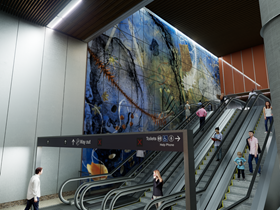
Excavated more than 27 metres below ground, the Roma Street underground cavern is one of the largest subterranean railway stations ever constructed in Australia. The engineering feat features a 280-metre-long station cavern, soaring central atriums, wide passenger concourses, and 16 high-speed escalators designed to carry up to 50,000 daily commuters between subterranean platforms and the surface busway interchange.
Pioneering European Train Control System (ETCS) Level 2 Digital Signalling
Cross River Rail functions as the technological catalyst for the complete modernization of Queensland Rail's network through the deployment of the European Train Control System (ETCS) Level 2. Developed and integrated in partnership with rail systems specialist Hitachi Rail, ETCS Level 2 replaces traditional lineside colored-light signals with digital, computer-based in-cab signalling and automated train protection (ATP).
The high-tech system continuously monitors train speed and location via radio communications and track-mounted Eurobalises, allowing trains to safely run at closer intervals with absolute safety. Following rigorous pilot testing along the Shorncliffe line, dynamic ETCS integration is being deployed across Queensland's 75 New Generation Rollingstock (NGR) trainsets, ensuring seamless automatic handovers as trains enter and exit the high-speed subterranean tunnels.
Four Landmark Underground Stations Anchoring Brisbane 2032 Olympic Mobility
The 10.2-kilometre alignment introduces four brand-new, architecturally bespoke underground stations: Boggo Road, Woolloongabba, Albert Street, and Roma Street, alongside eight fully upgraded suburban surface stations from Dutton Park to Salisbury. At Albert Street, the new station establishes the first rail stop in the Brisbane CBD in over a century, providing direct access to the Queen Street Mall, universities, and commercial financial towers.
State infrastructure ministers and civic leaders underscored that Cross River Rail serves as the foundational transit backbone ahead of the Brisbane 2032 Olympic and Paralympic Games, where the Woolloongabba and Roma Street stations will serve as primary transit hubs for world-class sporting arenas. By removing an estimated thousands of car trips daily from congested bridges and motorways, the electrified rail project slashes carbon emissions, promotes dense transit-oriented housing, and secures sustainable regional mobility for future generations.
📰 Related Stories
- Brisbane Accelerates $1.7 Billion All-Electric Metro Network with High-Capacity Bi-Articulated Fleet and Flash Charging Brisbane • Oct 13, 2026
- Brisbane City Council Deploys 100% Electric Bi-Articulated Metro Fleet and Completes Cultural Centre Station Upgrade Brisbane • Oct 06, 2026
- Queensland Advances Integrated Systems Testing and Station Fit-Outs on $6.3 Billion Brisbane Cross River Rail Megaproject Brisbane • Oct 05, 2026
- Queensland Awards $5.5 Billion Direct Sunshine Coast Rail Line Contract to CoastalTraX to Connect Beerwah and Caloundra Caloundra • Oct 17, 2026