Tasmania Accelerates Historic $786 Million New Bridgewater Bridge Megaproject Across the River Derwent
The Largest Single Transport Infrastructure Undertaking in Tasmanian History
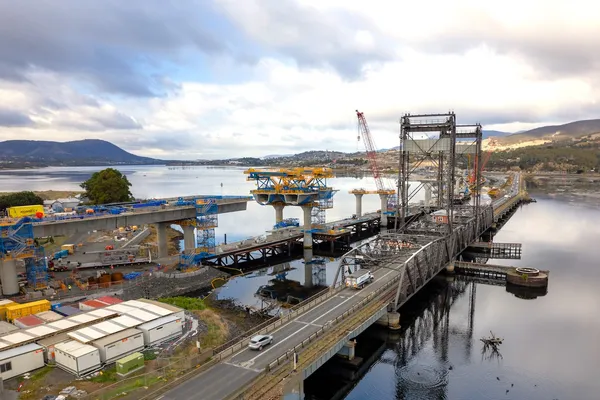
HOBART, Tasmania — In a historic leap forward for transport safety, economic productivity, and regional freight movement, the Australian Government and Tasmanian Government, in partnership with head contractor McConnell Dowell, are rapidly advancing construction across the monumental $786 million New Bridgewater Bridge Project. Spanning 1.2 kilometres across the River Derwent, the landmark crossing represents the largest single transport infrastructure investment ever undertaken in the history of Tasmania, replacing the obsolete 1940s lift bridge that has caused chronic traffic bottlenecks for decades.
Jointly funded on an 80:20 basis by federal and state governments, the megaproject delivers a modern four-lane, dual-carriageway bridge designed to full 100 km/h design standards. The new alignment seamlessly links the Brooker Highway on the southern shore at Bridgewater directly with the Midland Highway on the northern shore at Granton, slashing travel times for over 22,000 motorists and heavy freight vehicles that cross the Derwent daily.
Precision Marine Piling and High-Tech Precast Segment Assembly
Heavy marine construction across the dynamic tidal waters of the River Derwent has reached critical milestones. Engineering teams deployed specialized floating barge cranes and high-torque rotary drilling rigs to install 46 colossal reinforced-concrete bridge piers deep into the riverbed basalt bedrock. Massive concrete pier caps have been systematically poured to support the immense weight of the superstructure.
A core engineering marvel of the project is the deployment of over 1,000 custom-fabricated precast concrete bridge box segments. Manufactured locally at a dedicated, state-of-the-art precast facility established in Bridgewater, these monolithic segments—weighing up to 90 tonnes apiece—are transported to the riverbank and lifted into position using a high-capacity launching gantry. This balanced cantilever construction methodology minimizes disruption to the sensitive marine environment while ensuring rapid structural assembly.
Grade-Separated Interchanges and Dedicated Active Travel Corridors
The project scope extends well beyond the river crossing, comprehensively redesigning roadway junctions on both shores with modern grade-separated interchanges. At Granton and Bridgewater, complex roundabout removals and new overpass ramps eliminate dangerous cross-traffic intersections, substantially lowering regional vehicular accident rates and optimizing heavy freight movements between Hobart and the Port of Burnie.
In a transformative addition for local communities, the bridge incorporates a three-metre-wide protected shared path for pedestrians and cyclists, illuminated by eco-friendly LED fixtures and shielded by anti-throw barrier screens. The path connects into the wider Greater Hobart active travel network, offering breathtaking panoramic views of Mount Wellington (kunanyi) and the picturesque Derwent Valley while encouraging low-carbon commuting.
Generational Economic Stimulus and Local Workforce Training Across Tasmania
Tasmanian civic leaders and infrastructure ministers highlighted that the New Bridgewater Bridge functions as an extraordinary economic locomotive for the state, supporting more than 1,000 direct and indirect jobs during peak construction. Crucially, McConnell Dowell’s local procurement policy has ensured that over 85 percent of subcontracts and supply-chain expenditures are retained within Tasmanian businesses, alongside intensive apprenticeship programs upskilling local youth in heavy civil engineering.
With the removal of the restrictive lifting mechanism of the old bridge, river vessels will enjoy an unhindered 16.2-metre navigational clearance. Built to endure a 100-year design life, the New Bridgewater Bridge provides a resilient, high-capacity arterial conduit that will safeguard Tasmania’s freight efficiency, urban growth, and regional tourism for generations to come.
📰 Related Stories
- South Australia Advances $15.4 Billion Torrens to Darlington Project as T2D Alliance Prepares Triple TBM Fleet Adelaide • Oct 13, 2026
- Western Australia Delivers $1.65 Billion METRONET Ellenbrook Rail Line with Five Accessible Stations Across 21 Kilometres Perth • Oct 13, 2026
- Sydney Accelerates Multi-Billion-Dollar Transport Revolution as Sydney Metro West and Western Sydney Airport Reach Decisive Milestones Sydney • Oct 13, 2026
- Victoria Advances Landmark $33 Billion Suburban Rail Loop East with Tunnel Boring Machine Launches Across Melbourne Melbourne • Oct 13, 2026