Victoria Advances Landmark $33 Billion Suburban Rail Loop East with Tunnel Boring Machine Launches Across Melbourne
Revolutionizing Orbital Mass Transit Across Victoria's Capital
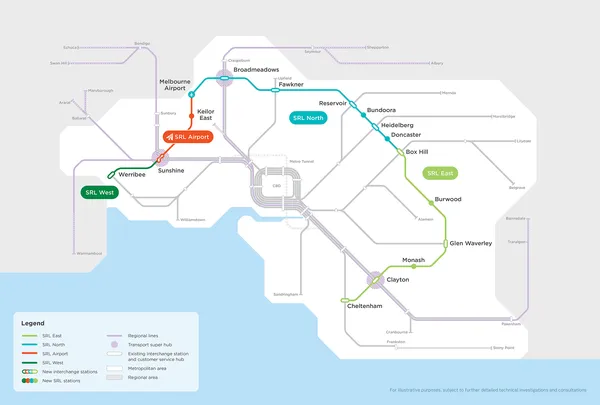
MELBOURNE, Victoria — In the most consequential transformation of Australia’s municipal passenger rail landscape in modern history, the Victorian Government and the Suburban Rail Loop Authority (SRLA)—under the unified umbrella of the Victorian Infrastructure Delivery Authority (VIDA)—have achieved landmark subterranean milestones on the monumental Suburban Rail Loop (SRL) East project. Spanning 26 kilometres of twin-bored underground tunnels from Cheltenham in Melbourne’s southern suburbs to Box Hill in the east, the multi-billion-dollar orbital rail line is engineered to fundamentally reorganize how Victorians move across Melbourne.
Rather than funneling every commuter into Melbourne's central business district through radial legacy tracks, SRL East establishes a high-speed orbital transit arc that directly interconnects major healthcare precincts, tertiary universities, retail commercial centers, and middle-ring employment districts in 20 minutes or less.
Launching Giant Tunnel Boring Machines Along the 26-Kilometre Alignment
Underground construction has entered its defining industrial phase with the formal assembly, underground lowering, and commissioning of massive, high-technology Tunnel Boring Machines (TBMs), including TBM Aayushi, at purpose-built launching portals in Clarinda and Burwood. Engineered by leading global tunneling consortia, these specialized earth pressure balance machines measure over 100 metres in length and weigh upwards of 1,000 tonnes apiece.
As the cutterheads excavate deep beneath suburban Melbourne’s complex geology, the TBMs systematically install precast reinforced-concrete tunnel lining rings manufactured at a specialized modular precast facility in Melton. The continuous tunneling drive will construct the dual 6.3-metre internal diameter running tunnels, creating the subterranean corridors required to operate high-frequency, driverless electric passenger trains at cruising speeds reaching 100 km/h.
Deep Station Box Excavations at Clayton, Monash, and Box Hill Superhubs
Concurrently, heavy civil engineering crews are executing mammoth deep-box excavations across the project's six dedicated underground stations: Cheltenham, Clayton, Monash, Glen Waverley, Burwood (serving Deakin University), and Box Hill. At Clayton, contractors are constructing an immense regional transport interchange featuring an elevated railway deck, subterranean pedestrian concourses, and seamless platform-to-platform transfers linking regional Gippsland rail services directly with the SRL underground alignment.
At Monash, the station box excavation plunges over 25 metres below ground level to create the university campus's first ever direct passenger rail connection, unlocking the world-class Monash Technology Precinct and nearby Australian Synchrotron for researchers and students. Each subterranean station incorporates full-height automated platform screen doors, dynamic natural light atriums, architectural acoustic dampening, and advanced climate control systems engineered for passenger comfort.
Anchor for Melbourne's Future 9 Million Population and Polycentric Economy
Victorian transport ministers and urban planners highlighted that the Suburban Rail Loop represents the essential infrastructural backbone needed to accommodate Greater Melbourne's projected population expansion toward 9 million residents over the coming decades. By creating dense, walkable, transit-oriented precincts around every station node, the project will deliver up to 70,000 new homes and foster major commercial clusters outside the congested CBD core.
Furthermore, the initiative supports over 8,000 direct engineering, construction, and trade jobs, enforcing Victorian Major Projects Skills Guarantee standards that ensure at least 10 percent of work is performed by apprentices, trainees, and engineering cadets. With tunneling progressing toward scheduled commercial service in 2035, SRL East stands as a generational nation-building asset setting a benchmark for sustainable orbital public mobility in the Southern Hemisphere.
📰 Related Stories
- Victoria Officially Delivers $15 Billion Melbourne Metro Tunnel Project with Five Landmark Underground Stations and High-Capacity Fleet Melbourne • Oct 06, 2026
- Victoria Advances Final Systems Testing and Architectural Fit-Outs on $15.3 Billion Melbourne Metro Tunnel Project Melbourne • Oct 05, 2026
- Victoria Advances Melbourne's $30 Billion Suburban Rail Loop East with Active Tunnelling and Linewide Transit Systems Melbourne • Oct 05, 2026
- Victoria Accelerates Suburban Rail Loop East as Massive Tunnel Boring Machines Advance Across Melbourne Following Full Metro Tunnel Commercial Integration Melbourne • Oct 03, 2026