Network Rail Reaches Superstructure Milestones on £211 Million Cambridge South Station Serving Biomedical Campus
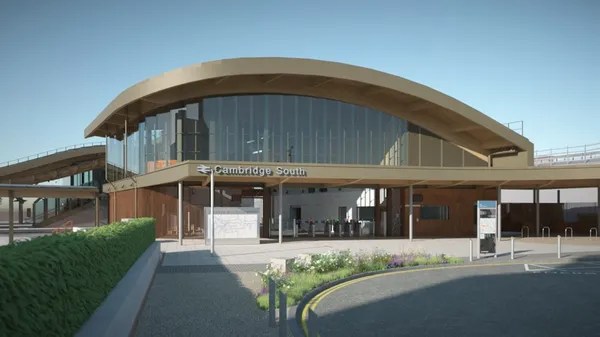
Transforming Rail Connectivity for Europe's Largest Life Sciences Cluster
CAMBRIDGE, Cambridgeshire — In a major boost for the United Kingdom's life sciences sector and sustainable regional mobility, Network Rail, the Department for Transport (DfT), and principal contractor J. Murphy & Sons Limited have achieved key structural engineering milestones on the landmark £211 million Cambridge South Railway Station. Located adjacent to the globally renowned Cambridge Biomedical Campus (CBC), the brand-new four-platform station establishes direct national rail connectivity to Europe’s premier hub for medical research, biotechnology innovation, and healthcare delivery.
The station directly serves world-leading institutions including Addenbrooke’s Hospital, the Royal Papworth Hospital, the MRC Laboratory of Molecular Biology, and the global corporate headquarters of pharmaceutical giant AstraZeneca. By connecting this powerhouse economic node directly to the rail grid, Cambridge South will accommodate thousands of daily healthcare staff, clinical specialists, patients, and academic visitors who previously relied on congested arterial highways like the M11 and A1307.
Complex Track Remodeling, Platform Decks, and Step-Free Accessible Footbridges
Delivering the station within one of the busiest rail corridors in Eastern England required extensive track remodeling along the West Anglia Main Line and the Shepreth Branch line. Civil engineering crews systematically replaced and slewed several kilometers of running track during tightly coordinated weekend possession windows, installing four new high-speed rail lines, continuous welded rails, and automated digital signalling infrastructure to allow stopping services without obstructing express passenger trains between London King's Cross, London Liverpool Street, and Cambridge.
Engineering teams have completed the heavy crane lifts for the station’s main precast concrete platform units and erected the monumental structural steel frame for the central passenger footbridge. Designed to full accessible design standards, the elevated concourse incorporates redundant high-capacity passenger elevators, escalators, architectural glass cladding, and energy-efficient LED wayfinding canopy lighting.
Multimodal Active Travel Hub with High-Capacity Cycle Parking
Reflecting Cambridge's renowned status as Britain's premier cycling capital, Cambridge South is engineered as an exemplary multimodal transport hub. Working in close coordination with the Greater Cambridge Partnership (GCP) and Cambridgeshire & Peterborough Combined Authority, the project integrates over 1,000 secure, covered cycle parking spaces, dedicated e-bike charging docks, and direct grade-separated ramp links into the regional active travel network.
Segregated pedestrian and cycling paths link the station portals directly with hospital concourses, research institutes, and the guided busway. The scheme eliminates the need for private vehicle drop-offs by prioritizing bus feeder interchanges and electric shuttle connections, reinforcing clean active transit across the southern fringe of Cambridge.
Catalyst for Global Innovation and Decarbonization Across the Oxford-Cambridge Arc
Transport ministers and scientific leaders emphasized that Cambridge South represents a pivotal foundational asset for the broader East West Rail vision, which will eventually reinstate direct passenger rail connections between Oxford, Milton Keynes, Bedford, and Cambridge. The Biomedical Campus workforce is projected to expand from 20,000 to over 30,000 professionals, and the new station will prevent an estimated 1.8 million car journeys annually, significantly curbing carbon emissions and regional air pollution.
Built to achieve BREEAM Excellent environmental certification with rooftop solar photovoltaics and sustainable stormwater attenuation, Cambridge South sets a new benchmark for integrated medical and science campus transit infrastructure in Britain.
📰 Related Stories
- Liverpool City Region Secures £96 Million Investment to Construct Landmark Liverpool Baltic Merseyrail Station Liverpool • Oct 13, 2026
- Birmingham Accelerates Landmark Curzon Street HS2 Station as Concrete Piling Concludes and Platform Decks Rise Birmingham • Oct 13, 2026
- Birmingham Advances Landmark £1.7 Billion West Midlands Transport Acceleration and Metro Extension Milestones Birmingham • Oct 13, 2026
- Glasgow Subway Progresses £288 Million Overhaul Toward Driverless Operations with New Stadler Fleet Glasgow • Oct 13, 2026