Liverpool City Region Secures £96 Million Investment to Construct Landmark Liverpool Baltic Merseyrail Station
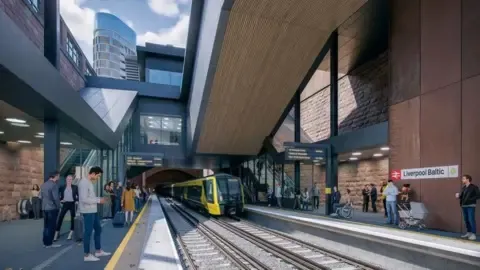
Reconnecting Liverpool's Creative Core to the Regional Rail Network
LIVERPOOL, Merseyside — In a transformative leap forward for public transit and urban regeneration across Northwest England, Liverpool City Region Metro Mayor Steve Rotheram and the Liverpool City Region Combined Authority (LCRCA) have formally approved a landmark £96 million funding package to construct the brand-new Liverpool Baltic Station on the Merseyrail Northern Line. Situated adjacent to the historic site of the former St. James Station—which shuttered passenger operations in 1917—the state-of-the-art station re-establishes rail connectivity to one of the UK’s fastest-growing creative, digital, and hospitality hubs.
Financed through the City Region Sustainable Transport Settlement (CRSTS) secured from the UK Department for Transport (DfT), the development forms the central flagship of the Metro Mayor’s 'Merseyrail for All' strategy. The initiative aims to expand high-frequency rail access across historically underserved residential communities in the southern inner core, providing direct mass transit connections to Liverpool Central, Moorfields, Southport, and Hunts Cross.
Universal Step-Free Accessibility and Modern Commuter Amenities
Designed to modern inclusive transit standards, Liverpool Baltic will feature complete unhindered step-free access from street level down to subterranean platforms via redundant high-speed passenger elevators and modern escalators. The design incorporates contemporary glass-canopied station pavilions, weatherproof waiting shelters, accessible customer restrooms, dynamic digital train information displays, and advanced CCTV security systems.
The station will be served by the region’s pioneering fleet of publicly owned Class 777 electric multiple units (EMUs) manufactured by Swiss train builder Stadler. Equipped with cutting-edge on-board battery energy storage technology, these low-floor trainsets operate with sliding step plates that bridge the gap to the platform edge, ensuring independent barrier-free boarding for wheelchair users, cyclists, and passengers with prams.
Active Travel Integration and Sustainable Urban Reinvestment
To foster healthy, zero-emission urban mobility, the scheme integrates extensive active travel infrastructure managed in coordination with Liverpool City Council. The project incorporates protected segregated cycle tracks along Parliament Street, widened pedestrian footpaths, tree plantings, and secure, monitored bicycle parking hubs linking the Baltic Triangle directly with Toxteth, the Knowledge Quarter, and the waterfront.
Regional civic leaders emphasize that the Liverpool Baltic station acts as a powerful economic catalyst, supporting thousands of creative and tech sector jobs while reducing private automobile dependency and easing gridlock along St James Street and the Strand. By aligning clean rail expansion with localized brownfield regeneration, the station propels the Liverpool City Region toward its ambitious target of achieving net-zero carbon status by 2035.
📰 Related Stories
- Merseyrail Expands Pioneering £500 Million Class 777 Battery-Electric Train Fleet and Network Reach Across Liverpool City Region Liverpool • Oct 05, 2026
- Liverpool City Region Accelerates 'Merseyrail for All' Network Expansion with Class 777 Battery Fleet and New Baltic Station Liverpool • Oct 05, 2026
- Liverpool City Region Backs Historic North Docks Development Corporation to Deliver 17,000 Homes as £86 Million Public Bus Franchising Takes Effect Liverpool • Sep 29, 2026
- Liverpool City Region Advances Baltic Rail Station Delivery and North Docks Masterplan Liverpool • Sep 24, 2026