Sydney Metro Western Sydney Airport Completes 23-Kilometre Track Installation and Advances Station Fit-Outs on $11 Billion Rail Link
Major Engineering Milestone for Western Sydney’s 23-Kilometre Rail Spine
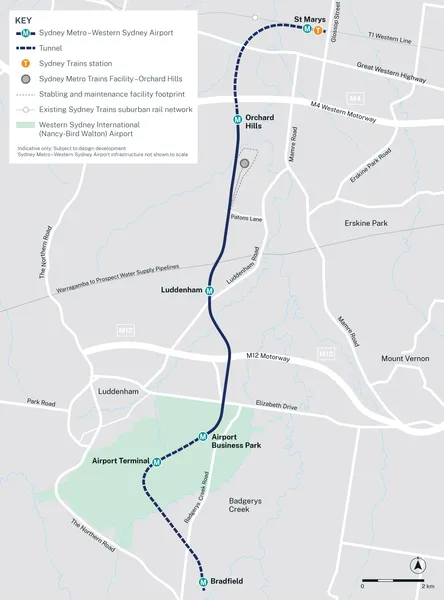
SYDNEY, New South Wales — In a pivotal achievement for Australia's largest public transport megaproject, the Australian and New South Wales Governments alongside Sydney Metro have finalized the complete installation of 23 kilometres of railway tracks on the $11 billion Sydney Metro – Western Sydney Airport line. Reaching 100 percent track completion marks the transition from heavy civil excavation to the comprehensive mechanical, electrical, and architectural fit-out of the six brand-new metro stations linking the St Marys commuter interchange directly to the upcoming Western Sydney International (Nancy-Bird Walton) Airport and the future Bradfield City Centre.
The monumental milestone follows the successful completion of 9.8 kilometres of twin tunneling excavated by four specialized tunnel boring machines (TBMs) and the erection of 3.5 kilometres of elevated concrete viaduct spans across Orchard Hills and Luddenham. With continuous steel track now connecting every section of the line, construction teams are focused on installing 25 kV AC overhead catenary electrical grids, advanced telecommunications cables, and cutting-edge platform screen doors.
Six Landmark Stations Connecting Commuter Hubs, Agribusiness, and Aerotropolis
The Sydney Metro – Western Sydney Airport line will provide fast, driverless transit connections across six strategically positioned stations: St Marys, Orchard Hills, Luddenham, Airport Business Park, Airport Terminal, and Bradfield. At St Marys, a major multimodal transit interchange unites the new metro with the existing Sydney Trains T1 Western rail corridor, allowing regional commuters from Penrith, Blacktown, and Parramatta to access the international airport in under 20 minutes without ever touching a congested motorway.
The two on-airport stations—Airport Terminal and Airport Business Park—will deliver seamless curbside transfers for domestic and international airline passengers, air-cargo logistics personnel, and business travelers. Further south, the line terminates at Bradfield, a brand-new, master-planned 24-hour green city centre positioned as the advanced manufacturing, aerospace engineering, and research powerhouse of Western Sydney.
Next-Generation Driverless Trains and High-Capacity Digital Signalling
Manufactured by international rail systems contractor Siemens Mobility under the Parklife Metro consortium, the driverless metro fleet introduces ultra-modern passenger rolling stock to Greater Western Sydney. The trains feature automated Communication-Based Train Control (CBTC) systems, walk-through open passenger gangways, dynamic digital route maps, luggage compartments designed specifically for airport passengers, and universal level-boarding platform interfaces.
Full-height, toughened glass platform screen doors installed across every station platform will synchronize with train operations, ensuring optimum passenger safety, barrier-free boarding for wheelchairs and strollers, and improved air-conditioned climate control throughout station concourses. Comprehensive power testing and dynamic train running trials are scheduled to begin along the test track segment between the Orchard Hills Stabling and Maintenance Facility and Luddenham Station.
Catalyzing Australia’s Third-Largest Economy and Slashing Road Freight Bottlenecks
Federal and NSW transport ministers underscored that the metro line represents the fundamental transit backbone of the Western Parkland City. By providing a carbon-neutral public transportation link ahead of Western Sydney International Airport’s commercial flight operations, the metro removes thousands of daily vehicle movements from arterial routes such as The Northern Road, the M4 Western Motorway, and Elizabeth Drive.
The project has generated over 14,000 direct and indirect jobs during construction, while unlocking long-term economic investment estimated at billions of dollars across Western Sydney. Together with solar-powered station microgrids, regenerative braking energy storage, and extensive water-sensitive urban design, the new metro establishes a world-class benchmark for sustainable regional connectivity in Australia.
📰 Related Stories
- Sydney Accelerates Multi-Billion-Dollar Transport Revolution as Sydney Metro West and Western Sydney Airport Reach Decisive Milestones Sydney • Oct 13, 2026
- New South Wales Accelerates $25 Billion Sydney Metro West Megaproject with Heavy Tunneling Breakthroughs and Station Cavern Excavations Sydney • Oct 13, 2026
- Sydney Celebrates Historic Transit Boom as Driverless Sydney Metro M1 Line Surpasses Millions of Passengers Beneath Sydney Harbour Sydney • Oct 05, 2026
- Victoria Advances Landmark $33 Billion Suburban Rail Loop East with Tunnel Boring Machine Launches Across Melbourne Melbourne • Oct 13, 2026