Berlin Advances €4.5 Billion Siemensstadt Square Megaproject as Topping-Out Reached and Framework Expands Residential Vision to 3,750 Sustainable Apartments
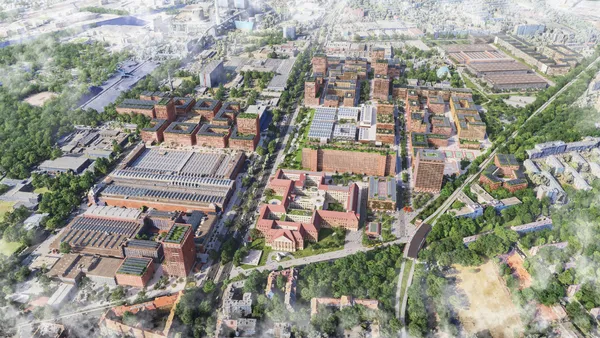
Landmark Urban Transformation in Western Berlin Reaches New Heights
BERLIN, Germany — In one of Europe’s most ambitious industrial redevelopments, Siemens AG, the Senate of Berlin, and the Spandau Borough Council are accelerating civil execution on the €4.5 billion Siemensstadt Square megaproject. Transforming a historic 76-hectare industrial campus into an open, carbon-neutral 'district of the future,' the project has celebrated its milestone topping-out ceremony and officially advanced an expanded master framework that nearly doubles its residential output to approximately 3,750 modern apartments.
Combining high-density sustainable housing, cutting-edge corporate research campuses, and vibrant civic spaces, Siemensstadt Square establishes a global benchmark for modern, transit-oriented 15-minute urbanism.
Europe’s Largest Wastewater Heat Exchanger and Decarbonized Energy
At the technological forefront of the district's carbon-neutral commitment is the installation and commissioning of Europe’s largest wastewater heat exchanger. Partnering with municipal utility Berliner Wasserbetriebe, the advanced district heating installation extracts thermal energy directly from Berlin's municipal wastewater collectors, channeling recovered warmth into high-efficiency industrial heat pumps to provide 100% fossil-free heating and cooling across residential and commercial buildings.
The localized energy network is reinforced by expansive rooftop photovoltaic solar generation, battery storage systems, and an intelligent digital smart-grid infrastructure that continuously optimizes building energy flows, eliminating fossil fuel reliance across the entire 76-hectare precinct.
Modern Educational Infrastructure and Mixed-Income Communities
Civic and social infrastructure is progressing rapidly on site. Municipal authorities have formally completed the land transfer for a brand-new, four-form elementary school in Spandau, with civil groundbreaking scheduled for early 2027 to serve the district’s growing resident population. The residential masterplan provides a balanced mix of rental housing, cooperative developments, and subsidized public housing units, complemented by inclusive daycare centers, artisan retail boulevards, and landscaped public parks.
Adjacent to the residential quarters, a dedicated high-tech campus is rising around the future railway station, anchoring global research institutions, tech incubators, and advanced manufacturing enterprises specializing in artificial intelligence, digital twins, and industrial automation.
Historic Siemensbahn Rail Reactivation Connecting to Central Berlin
Critical to the district's mobility framework is the comprehensive reactivation of the historic Siemensbahn S-Bahn rail line. Idle since 1980, the elevated 4.5-kilometer railway corridor is undergoing intensive civil reconstruction by Deutsche Bahn, with full passenger services slated to resume by 2029. State transport planners and municipal leaders emphasized that restoring direct S-Bahn rapid transit to central Berlin—paired with pedestrianized boulevards and bike highways—ensures Siemensstadt Square will thrive as a premier economic engine and sustainable urban community for the 21st century.
📰 Related Stories
- Berlin Marks Topping-Out Milestone on €4.5 Billion Siemensstadt Square Innovation Megaproject and Advances Siemensbahn Rail Reactivation Berlin • Oct 05, 2026
- Berlin Accelerates 'EinfachBauen' Fast-Track Construction Framework to Unlock 71,000 New Homes Amid Wide-Scale S-Bahn Transit Modernization Berlin • Oct 04, 2026
- Berlin Accelerates 'EinfachBauen' Fast-Track Construction Framework to Unlock 71,000 New Homes Amid Wide-Scale S-Bahn Transit Modernization Berlin • Oct 04, 2026
- Berlin Expands BVG Rapid Transit Network as Stadler Class J Trains Enter Daily Service on U5 Line with Siemens CBTC Semi-Automated Signaling Berlin • Sep 30, 2026