Brisbane Accelerates Rail Transformation Ahead of 2032 Games as Cross River Rail Enters Tunnel Testing and Electric Brisbane Metro Expands
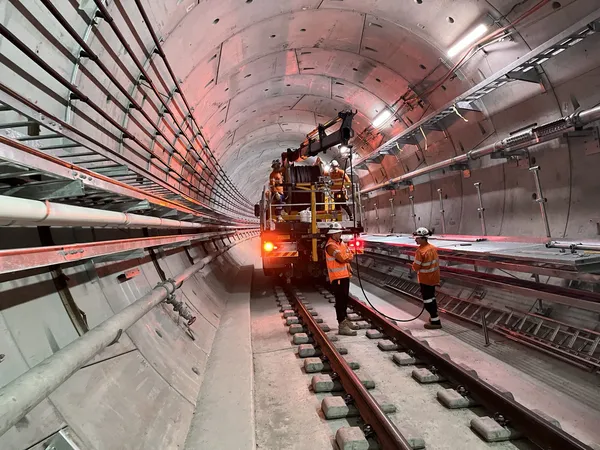
Dynamic Testing Underway Along Twin 5.9-Kilometre Subterranean Rail Tunnels
BRISBANE, Queensland — In a monumental stride toward revolutionizing public mobility across South East Queensland ahead of the Brisbane 2032 Olympic and Paralympic Games, the landmark $6.3+ billion Cross River Rail project has entered advanced multi-train dynamic commissioning. Operational teams from the Cross River Rail Delivery Authority and Queensland Rail are actively running test trains through twin 5.9-kilometre rail tunnels deep beneath the Brisbane River and central business district.
The rigorous testing phase validates the high-capacity European Train Control System (ETCS) Level 2 digital signaling network, precision platform screen door interfaces, and dynamic overhead traction power systems, paving the way to unlock Queensland’s busiest heavy rail bottlenecks.
Deep Underground Stations Transforming Roma Street and the CBD Core
Heavy mechanical and electrical fit-out is reaching completion across four massive underground cavern stations: Boggo Road, Woolloongabba, Albert Street, and Roma Street. Albert Street Station represents the very first railway station built in the Brisbane CBD in over a century, providing direct subterranean access into the heart of Queen Street Mall, financial office towers, and the vibrant riverfront.
At Roma Street, engineers are completing the state's largest multimodal transport hub, seamlessly interchanging subterranean high-capacity trains with suburban rail, long-distance interstate rail, regional coaches, and the city’s turn-up-and-go rapid bus corridors. Each underground station features soaring 30-metre-deep cavern concourses, full-height glass platform screen doors, automated passenger wayfinding, and architectural escalators engineered to move tens of thousands of passengers smoothly during major sports and cultural events.
Brisbane Metro Deploys 60 Zero-Emission Bi-Articulated Electric Vehicles
Complementing heavy rail subterranean upgrades, the Brisbane City Council has successfully expanded revenue service on its innovative Brisbane Metro network. Powered by a fleet of 60 Swiss-built HESS 24.5-metre bi-articulated electric vehicles, the Metro operates along dedicated busway corridors connecting the Royal Brisbane and Women’s Hospital, the Cultural Centre, and suburban transport terminals.
Featuring zero tailpipe emissions, spacious panoramic three-door boarding cabins carrying up to 150 passengers, and automated flash-charging overhead pantographs at depot termini, the Brisbane Metro delivers true subway-like frequencies without requiring overhead catenary wires along public thoroughfares.
A Sustainable Transport Legacy for South East Queensland
Queensland transport ministers and regional civic leaders affirmed that integrating heavy rail under the Brisbane River with high-capacity electric busways forms the bedrock of sustainable economic growth. As South East Queensland continues to attract record interstate and international migration, these coordinated transit super-projects ensure clean, reliable, and equitable mobility for millions of residents and visitors well beyond 2032.
📰 Related Stories
- Brisbane City Council Expands Turn-Up-and-Go Brisbane Metro as Electric Bi-Articulated Fleet Operates Across M1 and M2 Lines and Regional Extensions Advance Brisbane • Oct 03, 2026
- Queensland Advances ETCS Level 2 Signalling Validation and Station Commissioning Across $6.3 Billion Cross River Rail Project Brisbane • Sep 28, 2026
- Queensland Advances ETCS Level 2 Signalling Validation and Station Commissioning Across $6.3 Billion Cross River Rail Project Brisbane • Sep 28, 2026
- Western Australia Marks Major Transit Milestones as METRONET Armadale Line and 8km Byford Rail Extension Transform Commuter Corridors with Elevated Rail and Linear Parkland Perth • Oct 03, 2026