COVID-19 Trend Shifts to Summer Peaks in California, Experts Warn of Rising Cases
A Drastic Change in COVID-19 Patterns
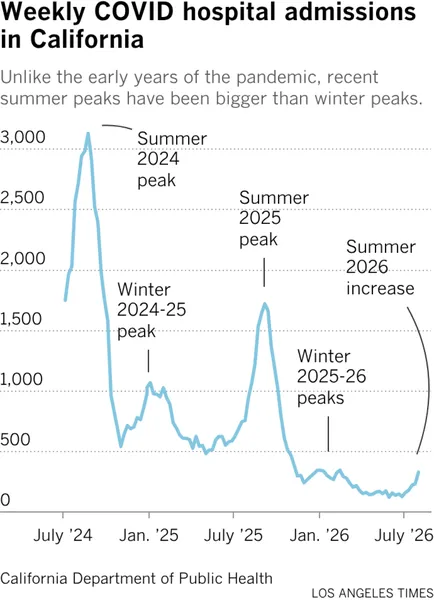
Experts in California are observing a significant shift in the COVID-19 pandemic, noting that cases are increasingly peaking during the summer months rather than the traditionally high winter season. This trend has been particularly pronounced in 2026, prompting California health officials to adjust their public health strategies to respond to a surge in infections.
According to the U.S. Centers for Disease Control and Prevention (CDC), COVID-19 cases are on the rise in 43 states, including California. The state is among only four where COVID wastewater activity levels remain at moderate or high levels.
Data Highlights Summer Surges
Dr. Erica Pan, the Director of the California Department of Public Health, highlighted in a recent briefing that the summer peak for COVID-19 cases was significantly higher in 2025 than any observed during the winter season. “If you have patients or loved ones who have not yet received the 2025-26 vaccines, it is still effective and highly recommended,” Dr. Pan remarked, emphasizing the importance of vaccination amidst rising COVID numbers.
The patterns reflect a broader national trend, where COVID-related emergency department visits peaked in late August 2025, with COVID accounting for 1.7% of visits, compared to only 1% during the winter peak. In California, peak emergency room visits reached 2.1% last summer, while the winter peak faltered at around 0.2%.
Understanding the Changing Dynamics
Historically, respiratory illnesses, including the flu and respiratory syncytial virus, have primarily surged in winter months; however, COVID-19 is exhibiting a distinct pattern. Over the early pandemic years, COVID spikes were observed in both summer and winter, with significantly more dangerous winter waves. In 2021, hundreds of thousands lost their lives during these winter surges.
Recently, however, experts have noted that summer spikes have become increasingly dominant. Dr. Peter Chin-Hong, an infectious disease expert at the University of California, San Francisco, stated, “We started seeing a very large summer increase in cases and wastewater in 2024, and that trend has continued.” The emergence of newer variants, including the FLiRT subvariant in 2024 and Nimbus and Stratus subvariants in 2025, may contribute to these summer surges.
Rising Hospitalizations and Recommendations
As infections rose, California's current hospitalization rate remains below previous years’ figures, with recent data showing 0.84 hospitalizations per 100,000 residents, down significantly from 1.92 a year ago. Despite the low rates compared to previous summers, health experts warn that vulnerable populations, including older adults and those with compromised immune systems, remain at high risk.
Health officials recommend that high-risk individuals receive the most recent vaccinations available, particularly those who have not been vaccinated in over a year. Dr. Chin-Hong encouraged immediate vaccination for at-risk patients, advising, “go and get the shot now, especially when we’re seeing that summer is the new winter in the last two years in California.”
Currently, California reported 1,813 COVID-19-related deaths in 2025, indicating that while the immediate threat appears reduced, the disease's presence remains a concern.
Ongoing Monitoring and Future Outlook
Officials expect a moderate rise in hospital admissions as summer progresses into early fall. The situation is further complicated by public uncertainty regarding vaccine availability, with some providers no longer stocking the 2025-26 vaccine. Experts advise assessing vaccination options but note that the next version is anticipated by late September.
Overall, COVID-19 is still a public health concern in California, one that requires vigilance through vaccination and preventive measures as we head into a potentially challenging fall season.
📰 Related Stories
- Sacramento PFAS Pesticide Tracking Bill Sent to Gov. Newsom Sacramento • Aug 28, 2026
- Sacramento Wildfire Liability Plan Puts California Utilities, Insurers and Survivors at Odds Sacramento • Aug 25, 2026
- California Senate Committee Rejects Controversial Animal Protection Bill Amid Election-Year Politics Sacramento • Aug 14, 2026
- San Diego MTS and Affirmed Housing Break Ground on $116M Spring View TOD as Airport Express Bus Expands San Diego • Sep 29, 2026