Met Council Advances $2.74 Billion METRO Green Line Extension with Track Completion and Systems Testing Across 16 Stations
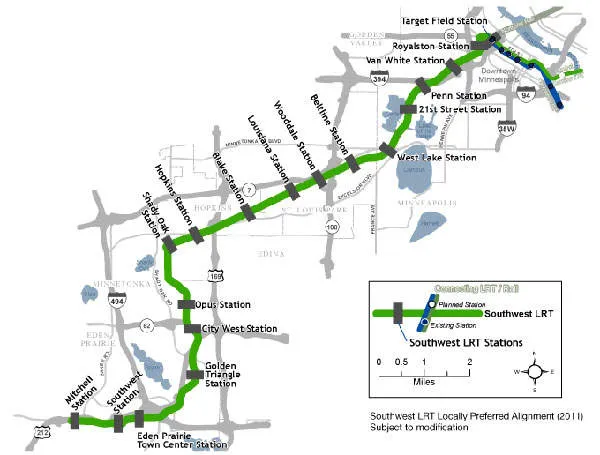
Expanding Twin Cities Transit with the 14.5-Mile Southwest Light Rail Trunk
MINNEAPOLIS, Minnesota — Advancing the single largest infrastructure endeavor in Minnesota's history, the Metropolitan Council (Met Council) and Metro Transit have achieved pivotal construction milestones across the landmark $2.74 billion METRO Green Line Extension (Southwest Light Rail Transit - SWLRT). Spanning 14.5 miles of double-track electrified light rail corridor, the high-capacity mass transit link extends the existing Green Line southwest from downtown Minneapolis through the thriving suburban communities of St. Louis Park, Hopkins, and Minnetonka to its southern terminus at SouthWest Station in Eden Prairie.
Backed by federal Capital Investment Grants (New Starts) from the Federal Transit Administration (FTA) alongside local county sales tax capital funding, the extension connects major commercial, educational, and healthcare employment clusters. Commuters traveling the entire corridor will experience direct, congestion-free transit in approximately 40 minutes, providing an equitable transit artery that bypasses severe recurring bottlenecks along Interstate 394, State Highway 100, and US Route 169.
Heavy Civil Completion Along Kenilworth Corridor and Advanced Electrification
Heavy civil contractor joint venture Lunda/C.S. McCrossan and systems specialist Aldridge-Parsons Joint Venture have surpassed 85 percent total project completion, finalizing key structural works on the specialized shallow cut-and-cover Kenilworth Corridor tunnel in Minneapolis. Engineered with continuous acoustic mitigation barriers, reinforced retaining diaphragm walls, and subterranean drainage pumps, the tunnel shields the neighboring Chain of Lakes recreational district from light rail operations while preserving scenic multi-use pedestrian and cycling parklands.
Civil teams have achieved contiguous track laying across the entire 14.5-mile guideway, installing thousands of pre-stressed concrete ties, continuous welded steel rails, and dozens of specialized track crossovers. Power crews are systematically energizing the 750-volt direct-current (DC) overhead catenary system (OCS) fed by 18 traction power substations, initiating low-speed clearance checks and dynamic vehicle integration tests.
Sixteen Multimodal Stations and Siemens S700 Light Rail Fleet Rollout
The corridor introduces 16 brand-new, universally accessible passenger stations, including eight integrated park-and-ride commuter hubs offering over 2,500 parking stalls. Stations feature heated passenger shelters, real-time arrival digital displays, emergency call kiosks, closed-circuit security cameras, and commissioned public artwork by local Minnesota artists celebrating indigenous and regional ecology.
Metro Transit is deploying a brand-new fleet of Siemens S700 low-floor light rail vehicles (LRVs) manufactured in Sacramento, California. Equipped with regenerative braking that returns kinetic power to the overhead electric grid, comfortable climate control engineered for sub-zero Minnesota winters, wide automated passenger doorways, and dedicated spaces for mobility devices and bicycles, the fleet delivers an accessible, turn-up-and-go rider experience.
Transit-Oriented Density and Regional Economic Prosperity
Regional planners and municipal leaders emphasize that the METRO Green Line Extension serves as a massive economic catalyst, having supported over 10,000 direct and indirect construction trades while unlocking billions in private capital investment. Transit-Oriented Development (TOD) zoning overlays enacted across Hennepin County are driving thousands of mixed-income multi-family housing units, biomedical labs, and retail plazas directly adjacent to station platforms.
By replacing an estimated 30,000 daily passenger vehicle trips and curbing thousands of metric tons of greenhouse gas emissions annually, the Green Line Extension establishes a durable, eco-friendly mass transit backbone for the Minneapolis-St. Paul metropolitan area for decades to come.
📰 Related Stories
- ICE Officer Christian Castro Charged With Lying About Minneapolis Shooting Minneapolis • Sep 04, 2026
- Minneapolis Christian Castro Extradition Bid Denied by Federal Judge Minneapolis • Aug 27, 2026
- Minnesota Extradition Lawsuit Targets Abbott Over Minneapolis ICE Shooting Case Minneapolis • Aug 19, 2026
- Mike Lindell Faces Campaign Law Violations in Minnesota Gubernatorial Race Delano • Aug 07, 2026