West Yorkshire Combined Authority Advances £2.1 Billion Mass Transit Tram Network Across Leeds and Bradford
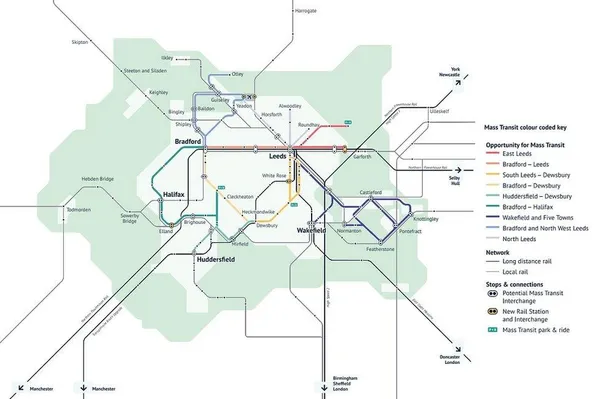
Transforming Transport Connectivity in the UK's Largest Unserved Urban Area
LEEDS, United Kingdom — The West Yorkshire Combined Authority (WYCA) has advanced pivotal planning and engineering frameworks for the multi-billion-pound West Yorkshire Mass Transit programme, formalizing statutory alignment under the region's newly released Spatial Development Framework. Supported by an initial £2.1 billion allocation from the government's City Region Sustainable Transport Settlement (CRSTS), the landmark transit project will deliver a state-of-the-art light rail and tram system to end Leeds' long-standing status as the largest metropolitan region in Europe without a modern rapid mass transit network.
Phase One priority alignments focus on two transformative transit corridors: the Leeds to Bradford Line, connecting the city centres of Leeds and Bradford via vital commercial and residential regeneration hubs, and the Leeds South Line, linking Leeds city centre with St James's University Hospital and the White Rose shopping and business campus. Civic transport models indicate that high-capacity trams running along segregated rights-of-way will slash cross-city transit journeys by up to 35 percent.
Integrated 'Weaver Network' and Spatial Economic Regeneration
Branded as the backbone of the region's 'Weaver Network', the mass transit system is engineered to integrate seamlessly with existing suburban rail services, municipal bus networks, and emerging active travel cycleways. The updated Spatial Development Framework ensures that upcoming local housing allocations, corporate business parks, and educational hubs are clustered directly around future tram halts, preventing suburban sprawl while driving sustainable, high-density brownfield urban renewal.
Engineering teams from WYCA are completing comprehensive ground investigations, utility mapping, and acoustic impact modeling along key arterial corridors including the A647 and southern orbital routes. All future tram stops will feature level-boarding platforms, tactile paving, smart tap-and-go contactless payment totems, and covered green-roof passenger shelters fitted with drought-resistant sedum vegetation.
Driving Clean Industrial Growth and Net-Zero Commitments
Mayor of West Yorkshire and regional civic leaders reaffirmed that the Mass Transit programme represents a once-in-a-generation lever for regional productivity and environmental stewardship. Construction and systems procurement across Phase One are projected to generate thousands of skilled engineering, civil construction, and electrical manufacturing jobs across West Yorkshire, boosting local supply chains and apprenticeships.
By shifting millions of passenger journeys from fossil-fuel vehicles onto clean, electrically powered light rail vehicles, the scheme will substantially improve urban air quality across central Leeds and Bradford, forming the cornerstone of West Yorkshire's statutory target to attain regional net-zero carbon emissions by 2038.
📰 Related Stories
- Three Teenagers Charged with Murder After Fatal Stabbing of 16-Year-Old Chloe Watson Dransfield in Leeds Leeds • Mar 31, 2026
- Glasgow Subway Advances to Final Driverless Readiness Testing Following Platform Screen Door Rollout Glasgow • Sep 25, 2026
- Transport for London Awards South Kensington Station Upgrade Contract to Deliver Step-Free Access and New District Line Platform London • Sep 25, 2026
- TfGM Secures Landmark Long-Term Renewable Power Agreement to Drive Greater Manchester's Zero-Emission Bee Network Manchester • Sep 25, 2026