Chicago TIF Study Finds Downtown Gains Deepened Neighborhood Inequality
Researchers say tax-increment financing delivered far more investment to central Chicago than to struggling South and West Side communities
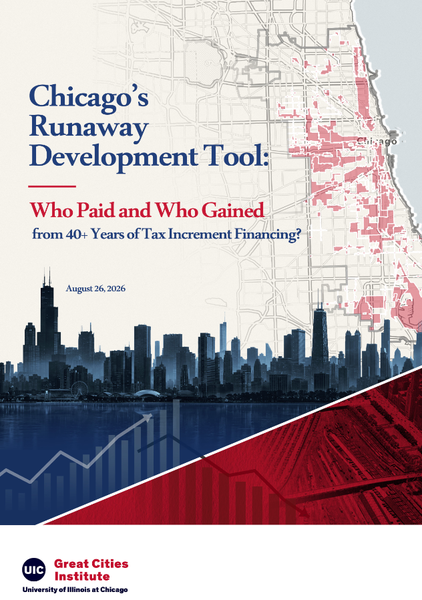
CHICAGO — Chicago’s long-running tax-increment financing program helped fuel the revival of the city’s downtown but did far less to transform poorer neighborhoods on the South Side and West Side, according to a sweeping study published Wednesday by the Great Cities Institute at the University of Illinois Chicago.
The analysis found that billions of dollars in TIF funding were concentrated in and around downtown, while communities with longstanding disinvestment received a comparatively small share of support for private development. Researchers said the findings raise questions about whether the program, created to revive struggling areas, has instead reinforced Chicago’s historic economic divide.
Tax-increment financing, commonly called TIF, was authorized by Illinois lawmakers more than four decades ago. Once the city creates a TIF district, the assessed value of property in that area is frozen for at least 23 years. Tax revenue generated by growth above that initial value is set aside for redevelopment projects in or near the district rather than flowing immediately to taxing bodies such as schools, parks, fire services and other local agencies.
Chicago launched its first TIF district downtown in 1984 and has used the mechanism more extensively than other major U.S. cities, according to the study. TIF money can pay for public infrastructure, parks, schools and affordable housing, as well as subsidies for private residential and commercial projects.
$9.4 billion tracked across 1,427 projects
Researchers spent more than a year reviewing contracts, tax rates and property assessments from Chicago’s TIF program. They identified $9.4 billion allocated to 1,427 public and private projects across the city, while noting that public records covered varying periods and included gaps and errors.
Of nearly $2.6 billion in TIF money tracked for private projects, about 64%, or roughly $1.6 billion, went to five neighborhoods in and around downtown. By comparison, five South and West Side communities together received $55 million for private projects — barely half the amount received by the Near North Side alone, the smallest recipient among the downtown neighborhoods examined.
The imbalance extended beyond private subsidies. Nearly half of the TIF spending researchers tracked since 1986 for projects including roads, parks and affordable housing was also focused in or near downtown.
Juan González, a senior research fellow at the Great Cities Institute, said the program had evolved into a development tool with insufficient public accountability. “Instead of reducing the city’s historic economic inequities, it has exacerbated them,” González said.
Study estimates higher costs for homeowners
The research also challenged a central argument made by TIF supporters: that subsidized projects generate property-value growth that would not otherwise occur. By comparing property values nearest to TIF projects with values farther away, the researchers estimated that more than 98% of property-value increases in TIF districts would have happened without the program.
That estimate drew caution from William Fulton, an urban studies professor at the University of California, San Diego, who was not involved in the research. Fulton said the comparison may not fully account for differences between parcels near projects and those farther away, making the 98% estimate likely too high.
Still, the study concluded that diverting tax growth to TIF accounts contributed to higher property-tax rates for homeowners over time. Researchers estimated that the owner of a $300,000 Chicago home paid an additional $878 in 2023 to offset revenue diverted into TIF districts, and $6,616 from 2014 through 2023.
One example cited was Google’s Midwest headquarters, which paid $7.6 million in property taxes in 2025. The study found that 98.2% of that payment went to a TIF account, while Chicago Public Schools received $73,126 — an amount researchers said was roughly equivalent to one teacher’s salary.
Mayor Brandon Johnson’s administration did not dispute that TIF is flawed. Spokesman Griffin Krueger said the city is moving away from dependence on the tool and pointed to a $1.25 billion housing and economic-development bond approved in 2024. The broader program is intended to invest up to $3 billion citywide by 2028, with a focus on affordable housing and commercial development on the South and West sides.
The researchers did not call for eliminating TIF, but recommended independent oversight, lower diversion of tax revenue from core public services and the eventual phaseout of downtown districts that have met their redevelopment goals. The city’s TIF system remains in place, and the debate over how its revenue should be distributed is ongoing.
📰 Related Stories
- Mayor Brandon Johnson Unveils 2027 Budget Engagement Report with UIC Ahead of Crucial City Council Fiscal Address Chicago • Oct 19, 2026
- Chicago Transit Authority Advances Historic $3.6 Billion Red Line Extension with $1.97 Billion Federal Grant Agreement Chicago • Oct 18, 2026
- Mayor Brandon Johnson Prepares 2027 Chicago Budget Address Following Council Debt Veto Win and Corporate Tax Push Chicago • Oct 18, 2026
- Chicago City Council Veto Override on Debt Threshold Falls One Vote Short as Aldermen Approve $260.8M Police Settlement Chicago • Oct 18, 2026