American Lung Association Finds Majority of Californians Exposed to Dangerous Air Pollution
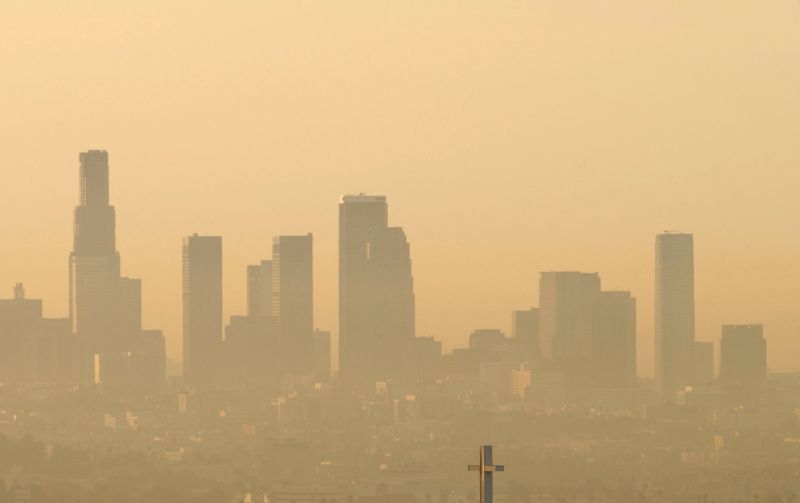
Los Angeles, California continues to face some of the nation’s dirtiest air, according to the American Lung Association’s 2026 State of the Air report released Wednesday. The Los Angeles-Long Beach metropolitan area topped the national rankings for ozone pollution, averaging more than 159 unhealthy ozone days annually. The region also appeared among the seven worst metro areas in the United States for both annual and short-term particle pollution.
The report assigns grades based on the number and severity of unhealthy air days, using federal air quality standards. Los Angeles, Riverside, and San Bernardino counties all received failing marks across every pollution category: ozone, annual particle pollution, and short-term particle pollution. Orange County also received failing marks for ozone and annual particle pollution, with a C for short-term particle pollution.
Experts from the American Lung Association noted that traffic-related emissions, industrial pollution, and the region's geography all contribute to persistently high pollution levels. Will Barrett, the association’s assistant vice president for nationwide clean air policy, pointed to vehicle exhaust, diesel usage, and refineries as primary contributors, with coastal conditions further pushing polluted air inland into areas like the Inland Empire.
Ozone, often described as smog, can irritate the lungs and aggravate respiratory problems. Fine particulate matter, or PM2.5, penetrates deeply into the body and is linked to serious health risks, including asthma, heart disease, and lung cancer. Children are especially vulnerable, as the report notes the long-term harm to lung development and increased rates of asthma attacks.
Despite these challenges, the Los Angeles region recorded its lowest annual level of particle pollution in the survey’s history. Across California, however, unhealthy air remains a widespread problem: 82% of state residents live in counties with failing air quality, compared to 44% nationally. Eight of the fifteen U.S. counties with the most ozone-polluted days are in California, as are nine of the fifteen counties with the worst year-round particle pollution.
Some California counties did show improvement. Sacramento posted record-low levels for both ozone and particle pollution, and Salinas, Chico, Santa Barbara, and San Luis Obispo were highlighted for cleaner air in certain categories.
The American Lung Association warned that recent federal policy shifts—including delays in stricter particle pollution standards and rollbacks of clean vehicle regulations—could undermine California’s efforts. The group called for continued state investment in emission reduction, especially in transitioning to zero-emission vehicles.
At present, authorities continue to track air quality trends as ongoing federal actions and local policies influence whether California’s most polluted regions can make further progress toward cleaner, healthier air.
📰 Related Stories
- LA Metro Board Greenlights $413 Million Vermont Transit Corridor as D Line Subway Prepares for 2027 Station Debuts Los Angeles • Sep 30, 2026
- LAX Automated People Mover Achieves 99.6% Construction Completion as Elevated Electric Train System Enters Final 30-Day Testing Ahead of Early 2027 Launch Los Angeles • Sep 30, 2026
- Los Angeles City Council Approves $466.6 Million Measure ULA Housing Package as Metro Orders 220 Electric Buses Los Angeles • Sep 30, 2026
- San Antonio Enacts $4.4 Billion FY 2027 Budget Expanding Housing to $37.7 Million as VIA Green Line Rapid Transit Progresses San Antonio • Sep 30, 2026