Sydney Metro Completes All 23 Kilometres of Tracklaying on Western Sydney Airport Driverless Rapid Transit Line
Historic Engineering Milestone Connects Sydney to the 24-Hour International Airport
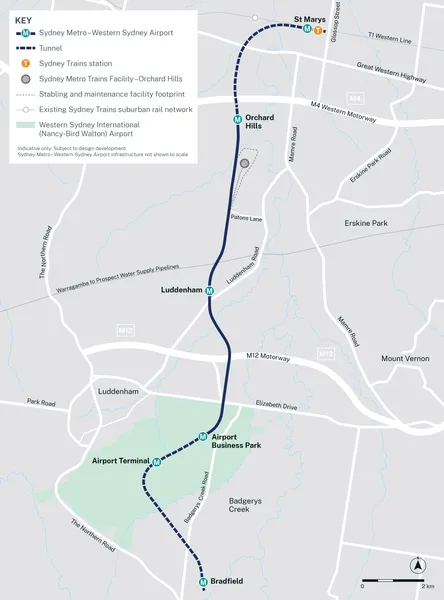
SYDNEY, New South Wales — In an epochal infrastructure achievement for Australia’s fastest-growing economic corridor, the New South Wales Government and Sydney Metro have celebrated the complete installation of 23 kilometres of railway tracks along the multi-billion-dollar Sydney Metro – Western Sydney Airport line. The final rail segment was fastened into place at the major northern multimodal interchange at St Marys Station, structurally completing the continuous steel permanent way connecting the existing suburban rail grid directly to the new international airport and the emerging Bradfield Aerotropolis.
The major milestone paves the way for linewide rail systems installation, overhead wiring energization, and rigorous dynamic train testing. When passenger operations commence, the fully automated, driverless metro will transport air travelers, airport personnel, and local commuters from St Marys to the terminal doors of the new Western Sydney International (Nancy-Bird Walton) Airport in just 15 minutes, and onward to the brand-new Bradfield City Centre in under 20 minutes.
Over 92 Kilometres of Australian Steel Rails and 76,000 Concrete Sleepers Installed
Executing the complex permanent-way installation over an intensive 15-month schedule, a specialized workforce of more than 450 railway engineers and track specialists laid a total of 92 kilometres of Australian-manufactured steel rails—amounting to 6,408 tonnes of steel—and securely anchored more than 76,000 high-strength concrete sleepers. The alignment spans twin 9.8-kilometre bored rock tunnels, 3.5 kilometres of elevated viaducts through Orchard Hills and Luddenham, and extensive at-grade earthworks.
With tracklaying complete, civil contractors are accelerating linewide fit-outs across the 23-kilometre corridor. Engineering teams are stringing high-voltage overhead catenary wiring, installing 33kV traction substations, running hundreds of kilometres of fiber-optic signaling and telecommunications cabling, and deploying fail-safe automated train control systems designed to maintain maximum operational reliability.
Six World-Class Stations Near Structural Completion with Platform Screen Doors
Rapid progress is also visible across all six newly constructed metro stations: St Marys, Orchard Hills, Luddenham, Airport Business Park, Airport Terminal, and Bradfield. All passenger platform decks are structurally complete, with civil fit-out teams actively installing 108 automated full-height glass Platform Screen Doors (PSDs) and positioning over half of the 40 heavy-duty escalators required across the underground and elevated stations.
Simultaneously, the first of the custom-designed, driverless three-car Siemens metro trainsets has commenced static testing at the high-tech Orchard Hills Stabling and Maintenance Facility. Tailored specifically for airport travelers, the state-of-the-art trains feature wide walk-through gangways, dedicated oversized luggage storage racks, real-time airline flight information displays, dynamic passenger digital route maps, and advanced accessibility seating.
Unlocking the Aerotropolis and Transforming Western Sydney's Economy
State infrastructure ministers, business chambers, and transport planners emphasized that the Western Sydney Airport Metro is the vital transport foundation for Australia's first 22nd-century city. The line will integrate with the T1 Western suburban line at St Marys, providing direct transit access for over one million residents across Parramatta, Blacktown, and Penrith to major employment zones, advanced manufacturing facilities, and international logistics parks.
By removing millions of vehicle trips from congested arteries like The Northern Road and the M4 Western Motorway, the driverless metro line delivers profound carbon abatement while cementing Western Sydney's status as a global hub for aviation, commerce, and sustainable urban living for generations to come.
📰 Related Stories
- Sydney Metro Commences Revenue Operations on Landmark 15.5-Kilometre Harbour Tunnel and City Extension to Sydenham Sydney • Oct 18, 2026
- Sydney Accelerates Multi-Billion-Dollar Transport Revolution as Sydney Metro West and Western Sydney Airport Reach Decisive Milestones Sydney • Oct 13, 2026
- New South Wales Accelerates $25 Billion Sydney Metro West Megaproject with Heavy Tunneling Breakthroughs and Station Cavern Excavations Sydney • Oct 13, 2026
- Transport for NSW Opens Landmark $2.875 Billion Parramatta Light Rail Stage 1 Connecting Westmead to Carlingford Parramatta • Oct 18, 2026