Milan Completes Full 15-Kilometre M4 Blue Metro Line Connecting San Cristoforo to Linate Airport in 30 Minutes
Connecting West to East Across Lombardy's Commercial Capital
MILAN, Lombardy — In a monumental achievement for urban mass transit, citywide decarbonization, and metropolitan mobility, the Municipality of Milan (Comune di Milano) and municipal transit authority Azienda Trasporti Milanesi (ATM) have officially completed and inaugurated the full 15.2-kilometre alignment of the M4 (Blue Line) Metro. Running continuously from San Cristoforo FS in the southwest across the historic city center to Milan Linate Airport in the east, the opening of the final 13-station western segment unites all 21 passenger stations, establishing a seamless high-speed subterranean spine beneath Italy’s commercial capital.
Constructed by the M4 S.p.A. concessionaire—a public-private partnership including civil construction leaders Webuild and Hitachi Rail Italy alongside the City of Milan—the transformative €1.8 billion megaproject slashes travel times across the metropolitan basin. Commuters can traverse the entire 15.2-kilometre cross-city alignment from San Cristoforo to Linate Airport in just 30 minutes, while passengers traveling from the central Piazza San Babila interchange reach airport terminal check-in desks in a breathtaking 12 minutes.
Fully Automated GoA4 Driverless Technology and Hitachi Rail Fleet
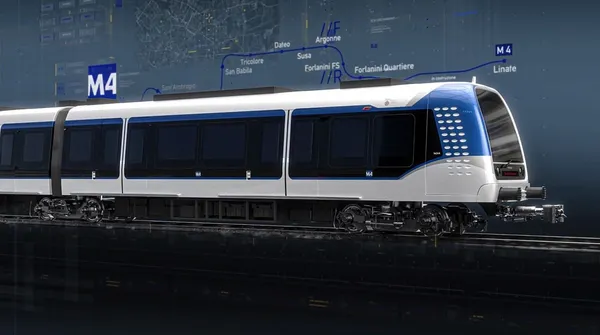
The M4 Blue Line operates with state-of-the-art Grade of Automation 4 (GoA4) unattended driverless technology, governed by high-performance Communication-Based Train Control (CBTC) digital signaling. The line is served by a bespoke fleet of 47 articulated four-car trainsets built by Hitachi Rail at its Italian manufacturing facilities, designed for whisper-quiet travel, rapid acceleration, and maximum energy conservation.
Each trainset features wide, unobstructed gangways, integrated Wi-Fi, USB charging ports, intelligent climate control, and digital dynamic passenger information displays. At peak commuting hours, the driverless CBTC signaling system permits tight train headways of under 90 seconds, enabling the line to transport up to 24,000 passengers per hour in each direction. For maximum traveler safety, every platform is equipped with full-height, automated glass Platform Screen Doors (PSDs) that synchronize precisely with train doors, optimizing passenger boarding while reducing tunnel airflow resistance and cooling loads.
Seven Strategic Transit Interchanges Uniting the Regional Rail Web
The M4 alignment is engineered as a masterclass in urban integration, incorporating seven strategic interchange hubs that unite Milan’s broader transit network. Passengers can effortlessly connect to the Red Line (M1) at San Babila, the Green Line (M2) at Sant'Ambrogio via a newly bored underground pedestrian link, and the Yellow Line (M3) at Sforza Policlinico via an enclosed interchange.
Furthermore, the line links directly with regional, national, and suburban railway services (Passante Ferroviario) at San Cristoforo FS, Dateo, and Milano Forlanini stations. All 21 stations are built to full universal accessibility guidelines, incorporating redundant high-speed elevators, escalators, tactile ground paths for visually impaired commuters, and 24/7 centralized video surveillance monitored from ATM's master operations control center.
Massive Catalyst for Urban Decarbonization and Public Realm Transformation
Municipal leaders and environmental planners emphasized that the M4 Metro functions as a cornerstone of Milan's Climate and Clean Air Plan (PAC). Projected to carry over 86 million passengers annually, the line avoids an estimated 180,000 private vehicle trips per day, eliminating up to 75,000 tonnes of carbon dioxide emissions each year and dramatically improving air quality across the Po Valley.
Above ground, the construction completion has catalyzed a profound public realm renaissance. The City of Milan has reclaimed more than 240,000 square meters of urban surface area along the route, transforming former traffic arteries into pedestrian plazas, tree-lined boulevards, and protected cycle lanes. With thousands of newly planted trees and expanded public green spaces restoring neighborhoods along the Naviglio Grande and Corso Europa, the completed M4 Blue Line stands as a shining beacon of sustainable European urbanism for the 21st century.
📰 Related Stories
- Milan Completes Historic 15-Kilometre Driverless M4 Blue Metro Line Linking Linate Airport to San Cristoforo Milan • Oct 13, 2026
- Milan Celebrates Transformative Mobility Milestone as 15-Kilometre Driverless Metro Line M4 Achieves High-Frequency Operations Across 21 Stations Milan • Oct 04, 2026
- Milan Completes Full 15-Kilometer Metro Line 4 Opening as San Cristoforo FS Directly Connects to Linate Airport Across 21 Automated Stations Milan • Sep 30, 2026
- Rome Advances €776 Million Metro Line C Northward Extension to Flaminio and Launches 121 Zero-Emission Trams Across TVA Transit Corridor Rome • Sep 29, 2026