Swiss Federal Railways Advances CHF 3.1 Billion Brüttenertunnel Project to Expand Rail Capacity Between Zurich and Winterthur
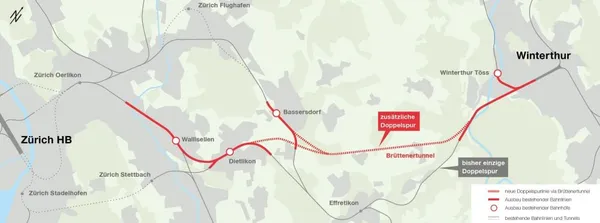
Eliminating Switzerland's Foremost Rail Transit Bottleneck
ZURICH, Canton of Zurich — In one of the most consequential rail infrastructure undertakings in modern Swiss history, Swiss Federal Railways (SBB / CFF / FFS) and the Federal Office of Transport (BAV / OFT) have advanced decisive planning, procurement, and site preparation milestones on the monumental CHF 3.1 billion MehrSpur Zürich–Winterthur (Brüttenertunnel) Project. Situated within the economic engine of Switzerland, the railway corridor between Zurich and Winterthur is the most heavily traversed rail trunk in the nation, carrying over 120,000 passengers and 300 trains daily across existing twin tracks through Effretikon and Wallisellen, operating at maximum capacity limits.
Serving as the flagship centerpiece of the federally mandated STEP 2035 (Strategic Development Programme for Railway Infrastructure), the megaproject constructs an entirely new, direct underground express rail corridor that will expand line capacity to up to 900 trains per day, unlocking nationwide quarter-hourly intercity and regional S-Bahn schedules while dramatically improving reliability across Eastern Switzerland.
8.3-Kilometre Twin-Tube Brüttenertunnel Excavated with Advanced TBMs
The cornerstone of the project is the **8.3-kilometre twin-tube Brüttenertunnel**, running beneath the Brütten plateau between Dietlikon and Bassersdorf in the west and Winterthur in the east. Engineered for speeds of up to 160 km/h, the twin bored single-track tunnel tubes will be excavated utilizing state-of-the-art slurry shield Tunnel Boring Machines (TBMs) designed to safely navigate complex molasses bedrock and water-bearing gravel strata without disturbing surface settlements.
SBB engineering teams are executing comprehensive preparatory works, constructing specialized logistics loading platforms and rail-based material sidings to ensure that millions of cubic meters of excavated tunnel spoil are transported exclusively by zero-emission electric freight trains rather than heavy road trucks. Continuous cross-passages every 500 meters, emergency egress caverns, and automated deluge safety systems guarantee state-of-the-art tunnel safety standards.
Multimodal Grade-Separated Rail Junctions at Bassersdorf and Dietlikon
To integrate the new high-speed subterranean alignment seamlessly into the existing rail network without causing conflicting movements, the project delivers complex grade-separated flying junctions (flyovers and underpasses) at Dietlikon, Bassersdorf, and Tössmühle. In Winterthur, extensive track remodeling and platform expansions at Winterthur Hauptbahnhof will ensure smooth throughput for high-speed EuroCity trains operating to Munich, InterCity services toward St. Gallen, and suburban Zurich S-Bahn lines (S8, S11, S12).
Stations along the surrounding commuter network, including Bassersdorf and Dietlikon, are undergoing comprehensive modernization with extended 400-metre platform decks, full barrier-free accessibility compliant with the Swiss Disability Discrimination Act (BehiG), dynamic digital passenger information displays, and expansive multi-storey park-and-rail commuter hubs.
Decarbonizing Regional Mobility and Strengthening the Swiss Confederation's Rail Network
Swiss federal transport directors and Zurich cantonal authorities emphasized that the MehrSpur Zürich–Winterthur megaproject represents an indispensable cornerstone of Switzerland’s long-term climate action strategy, which targets net-zero carbon emissions by 2050. Powered 100 percent by renewable hydroelectric traction power from SBB's sovereign alpine power stations, the expanded rail corridor will divert tens of thousands of daily commuter vehicle trips away from the notoriously congested A1 motorway.
Furthermore, the scheme incorporates extensive environmental compensation programs, restoring ecological wetlands along the Glatt and Töss river basins, creating wildlife corridors, and installing specialized noise-absorbing track beds and acoustic barrier walls. Representing a triumph of Swiss precision engineering, the Brüttenertunnel secures high-capacity, dependable mass mobility between Zurich, Winterthur, and international hubs for the next century.
📰 Related Stories
- Swiss Investigators Probe Deadly New Year’s Bar Fire in Crans-Montana Crans-Montana • Jan 04, 2026
- Dozens killed in New Year bar fire at Crans-Montana ski resort Crans-Montana • Jan 02, 2026
- British Wingsuit Champion Liam Byrne Dies During Swiss Alps Jump Leaving a Legacy of Fearless Flight Gitschen Mountain • Jun 24, 2025