Northern Illinois Transit Authority Assumes Regional Transit Oversight as CTA Completes Phase 1 of $2.1 Billion Red-Purple Modernization
Northern Illinois Transit Authority Unifies Regional Transit Governance
CHICAGO, Illinois — Marking the most consequential structural overhaul of Chicago’s public transit network in over four decades, the newly established Northern Illinois Transit Authority (NITA) has officially commenced formal oversight and regional policy coordination across northeastern Illinois' mass transit providers. Superseding the legacy Regional Transportation Authority (RTA) framework, NITA consolidates executive financial strategy, timetable harmonization, and fare integration across the Chicago Transit Authority (CTA), Metra commuter rail, and Pace suburban bus networks, securing long-term operational stability and definitively averting the post-pandemic fiscal cliff that once threatened severe regional service reductions.
Under the unified governance architecture, NITA is charged with establishing seamless cross-agency transfers, coordinating synchronized scheduling matrices at key suburban hubs, and expediting capital megaprojects to rebuild ridership and drive economic vitality across the greater Chicago metropolitan area.
Substantial Completion Reached on $2.1 Billion Red and Purple Modernization
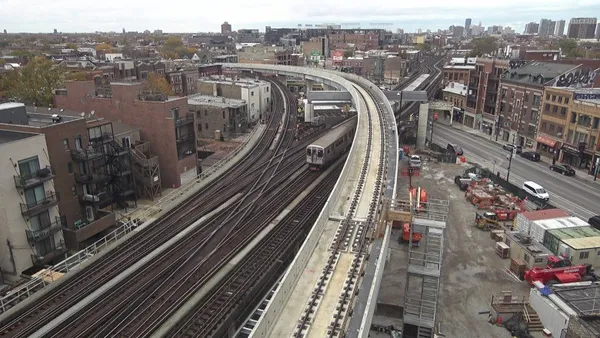
Coinciding with the regional governance transition, the CTA announced that Phase One of the landmark $2.1 billion Red and Purple Modernization (RPM) project has reached substantial completion on Chicago’s North Side. The generational capital undertaking—the largest singular infrastructure investment in the CTA's history—has completely reconstructed nearly two miles of century-old four-track elevated rail structures between Lawrence Avenue and Bryn Mawr Avenue.
Central to the project's engineering achievements is the operational success of the Red-Purple Bypass at Belmont, a grade-separated flyover structure that eliminated a notorious rail bottleneck where northbound Brown Line trains historically crossed Red and Purple Line tracks. By removing train idling and conflicting track movements, the bypass has increased system throughput, allowing CTA dispatchers to run up to eight additional trains per hour during peak travel rushes.
Four Fully Accessible Modern Stations and Noise-Attenuating Trackways
As part of the RPM Phase One delivery, four historic stations—Lawrence, Argyle, Berwyn, and Bryn Mawr—have been completely transformed into contemporary, step-free transit hubs. Each facility now features high-capacity glass elevators, wide island platforms, energy-efficient LED lighting, tactile guidance tiles, and real-time electronic transit tracker displays, bringing full Americans with Disabilities Act (ADA) accessibility to thousands of daily commuters.
The newly laid elevated trackbed incorporates specialized closed-deck concrete bridges and ballast mat sound barriers, significantly mitigating wheel noise and structural vibrations for surrounding dense residential and commercial neighborhoods along Broadway and Winona Street.
Full Momentum Toward the $3.6 Billion Red Line Extension to 130th Street
With Phase One of RPM reaching completion, CTA leadership and city planners have shifted heavy focus toward the long-anticipated $3.6 billion Red Line Extension (RLE). Extending the southern terminus 5.6 miles from 95th/Dan Ryan to 130th Street, the project will construct four brand-new multimodal stations at 103rd Street, 111th Street, Michigan Avenue (near 116th), and 130th Street on the Far South Side.
Backed by substantial federal funding commitments from the Federal Transit Administration (FTA) Capital Investment Grants program, early utility relocations and engineering site investigations are accelerating through late 2026, setting the stage for major civil construction that will connect historically transit-underserved communities to downtown Chicago jobs, higher education, and healthcare.
📰 Related Stories
- Chicago Transit Authority Transitions to Reconfigured Regional Board Under NITA Act as City Manages FY 2026 Fiscal Operations Chicago • Sep 26, 2026
- CTA Advances Heavy Construction on $5.7 Billion Red Line Extension as Walsh-VINCI Mobilizes 130th Street Transit Corridor Chicago • Sep 26, 2026
- Chicago City Council Deliberates One-Year Data Center Moratorium as West Loop Approves 26-Story Residential Tower Chicago • Sep 26, 2026
- Chicago Health Officials Issue Exposure Alert at Union Station as OEMC Unveils Weekend Safety Plan Chicago • Sep 25, 2026