Longview Paper Mill Tank Failure Followed Warnings That Vessel Was Unsafe
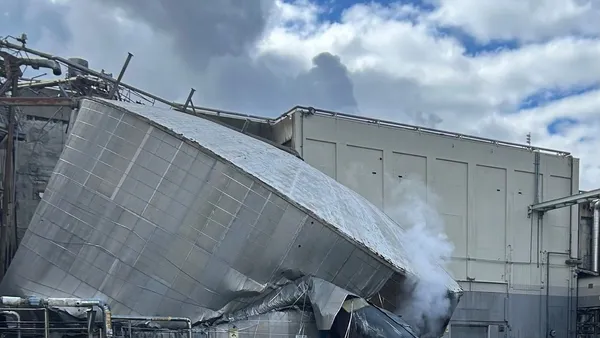
Federal safety board says tank had extensive wall thinning before deadly release
LONGVIEW, Washington — The chemical tank that failed at a Longview paper mill in May, killing 11 workers, had been identified by an inspection contractor 10 months earlier as not fit for continued service unless repairs were made, according to a new federal investigative update released Friday.
The U.S. Chemical Safety Board said the tank at Nippon Dynawave Packaging Company’s Longview facility released about 900,000 gallons of white liquor on May 26. The caustic chemical, used in the papermaking process to break down wood, blew out building walls, flooded lower levels of the facility and caused severe chemical burns to workers and a firefighter.
The Longview paper mill tank failure occurred shortly after employees began arriving for work at about 7 a.m. Investigators said the release reached areas where workers were holding morning meetings, turning a routine shift change into one of the deadliest U.S. workplace disasters in recent decades.
Inspections flagged critical concerns in 2025 and 2026
Applied Technical Services LLC conducted an external inspection of the tank in July 2025 and found significant thinning in its lower sections, with areas below the calculated minimum safe wall thickness, the safety board said. That measurement is intended to show whether a tank can safely withstand the pressure of its contents and support its own weight.
An excerpt from the July inspection classified the issue as a Priority 1 concern and stated that the vessel was “not fit for continued service unless corrected.” The report recommended an internal inspection to determine the extent of repairs and said replacement of an entire shell course was likely needed.
According to the board, follow-up exterior inspections in October 2025 and February 2026 found that large sections of the tank remained thinner than the minimum safe thickness. Nippon Dynawave did not conduct the recommended internal inspection or shell repairs between the July inspection and the May 2026 collapse, investigators said.
The company also did not remove the tank from operation or reduce its service level, a process known as derating, the board said. CSB Chairperson Steve Owens said the agency was greatly concerned that the tank was not promptly taken out of service or properly repaired after the inspection findings.
Flow disruption preceded the tank’s collapse
The board’s preliminary account describes a series of events before the failure. At about 2 a.m. on May 26, a digestor vessel at the mill was removed from service for repairs. The tank subsequently stopped sending white liquor to that vessel, but additional white liquor continued flowing into the tank.
By around 6:20 a.m., the tank was nearing full capacity. It failed less than an hour later, sending the chemical into a courtyard, crushing vehicles and damaging a nearby building before the liquid reached lower floors of surrounding work areas.
Eight employees in an electrical maintenance shop and one worker in the courtyard were killed, the federal update said. In a mechanical maintenance shop, five employees and a foreman escaped, but two workers later died from chemical exposure. Two survivors suffered serious burns.
Investigators also said the mill radioed for its medical emergency response team without explaining that white liquor had been released. A team member entered what was believed to be water to rescue an employee and was seriously burned after wading into the chemical.
Nippon spokesperson Sam Jefferies said the company would not comment on individual findings while the investigation remains open. The company said it is supporting affected families and employees, working toward fully reopening the Longview facility and cooperating with federal investigators.
The Association of Western Pulp and Paper Workers called the findings deeply troubling and said workers’ families deserve a full accounting of how inspection recommendations were communicated and considered. Separately, the Washington Department of Ecology recently issued Nippon Dynawave notice of 35 environmental violations. The Chemical Safety Board said its investigation remains ongoing, with final findings to be released in a future report.
📰 Related Stories
- Sound Transit Opens $3.1 Billion Lynnwood Link Light Rail Extension Connecting King and Snohomish Counties Seattle • Oct 13, 2026
- Historic Elwha River Lands Returned to Lower Elwha Klallam Tribe as Seattle Civic Groups Launch Midterm Coalition Seattle • Oct 13, 2026
- Historic Elwha River Dam Project Reaches Final Milestone with Tribal Land Transfers as Lumen Field Recognizes Decarbonization Leaders Seattle • Oct 13, 2026
- San Francisco Enacts 45-Day Data Center Moratorium Amid Power Grid Strains and Surging Housing Pressures San Francisco • Oct 13, 2026