Miami Beach Climate Resilience Projects Test New Ways to Live With Rising Water
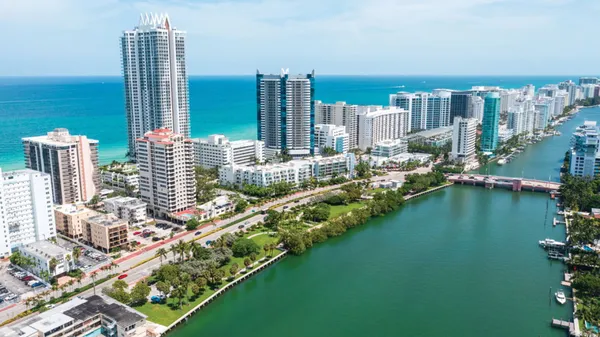
Designers across South Florida are combining flood protection, housing and public space
MIAMI BEACH, Florida — Coastal designers in Miami Beach and nearby South Florida cities are putting climate resilience at the center of new housing, seawalls and public parks as rising seas, tidal flooding and stronger storm surges reshape how communities prepare for the future.
The work is rooted in a hard lesson from Hurricane Andrew, the Category 5 storm that tore through South Florida in 1992. Jeffrey Huber, now a landscape architect, professor at Florida Atlantic University’s School of Architecture and principal architect on a major Miami Beach housing project, was 12 when Andrew ripped the roof off his family’s home. His family depended on donated food after first responders were unable to reach them and later lived in a trailer for more than a year.
Huber said the experience shaped his approach to designing for not only a storm’s immediate destruction but also the prolonged disruption that follows. With roughly 129 million people living in U.S. coastal counties, the need for practical adaptation is growing as human-driven sea-level rise increases the frequency of extreme coastal flooding.
Elevated senior housing designed for storm surge
In Miami Beach, the 119-unit Vista Breeze affordable senior housing development illustrates how building design can account for water rather than simply attempt to hold it back. The two-building complex, designed by Brooks Scarpa Huber, is elevated 10 feet above sea level and engineered to withstand storm surges as high as 20 feet.
The project uses concrete mixed with a crystalline waterproofing material intended to prevent water penetration, while zinc-coated rebar is intended to reduce corrosion. Huber said such measures are relatively straightforward additions that can extend the useful life of buildings exposed to saltwater and flooding.
Its layout also addresses South Florida’s heat. The buildings face southeast to catch prevailing breezes for passive cooling, while courtyards, terraces and community rooms provide gathering space. Prominent stairways and less visible elevators were incorporated to encourage residents to use the stairs.
Living seawalls bring habitat into flood defenses
About 30 miles north in Fort Lauderdale, startup Kind Designs has been installing 3D-printed seawalls that are designed both to reduce wave force and support marine life. Founder Anya Freeman said repeated street flooding in Miami Beach, including water deep enough to threaten parked cars, led her to leave her legal career and launch the company in 2024.
Unlike conventional flat seawalls, the company’s structures can be shaped like mangrove roots, barnacle clusters and other natural coastal forms. The textured surfaces create shelter for marine species and help break up wave energy. Freeman said the walls dissipate at least 45% of wave energy, reducing vulnerability to overtopping and erosion.
Researchers at Florida International University found 51 species living on one installed wall within a year, including oysters and tubeworms that filter water, according to the company. Kind Designs has installed 16 living seawalls for residential, commercial and government clients across Florida, and plans installations in California and New York as well as work involving U.S. Navy coastal bases.
Fort Lauderdale is also using public landscape as infrastructure. DC Alexander Park, built on a former parking lot, includes a 25-foot artistic overlook and a perimeter maritime forest of native vegetation intended to absorb rainwater and saltwater flooding while creating habitat and recreation space.
Funding remains a central obstacle
Planners say the biggest barriers are no longer limited to engineering. Financing, regulation and community support can determine whether resilient designs reach the lower-income neighborhoods that often face the greatest climate risks. At the University of Miami’s Center for Urban and Community Design, director Thomas Klein is developing a community design fund to help residents identify and advance high-impact resilience projects.
South Florida designers are also proposing larger regional systems, including storm-surge protections and “sponge parks” that absorb rainfall and manage runoff. The projects remain works in progress, but Miami Beach, Fort Lauderdale and other coastal communities are increasingly treating flood protection as part of everyday housing, transportation and public-space planning rather than as a separate emergency measure.
📰 Related Stories
- Boxing Champion Gervonta Davis Arrested in Miami Following Alleged Domestic Dispute Miami Beach • Jul 12, 2025
- Mayor Donna Deegan Issues Executive Order Mandating Financial Governance Training for City Boards and Agencies Jacksonville • Oct 19, 2026
- Jacksonville City Council Unanimously Approves $30M Gas Tax Relief to Rescue JTA Operations and Transit Routes Jacksonville • Oct 18, 2026
- Mayor Michelle Wu Outlines 2031 Public School Academic Targets and Dispatches Congestion Pricing Delegation Boston • Oct 23, 2026