Chicago’s $9B Quantum Shore Project Faces South Side Opposition
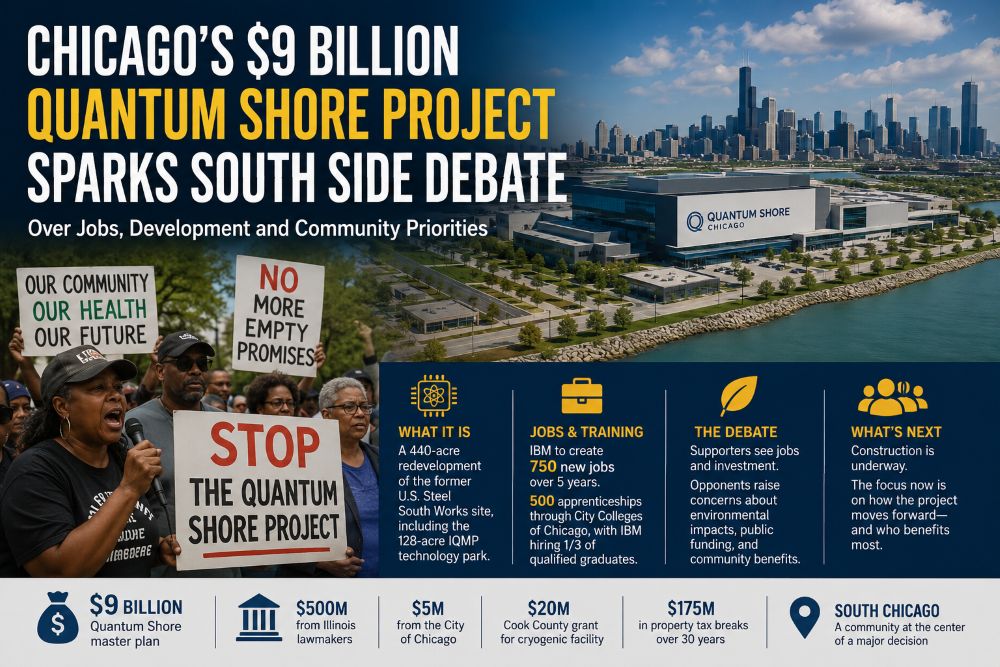
Chicago’s $9 Billion Quantum Shore Project Sparks South Side Debate Over Jobs, Development and Community Priorities
Chicago’s ambitious push to turn the former U.S. Steel South Works property into a major quantum-technology and innovation hub is facing renewed opposition from South Side residents, putting one of the city’s largest proposed technology developments at the center of a growing debate over jobs, environmental protection, public funding and community control.
The latest dispute intensified after Mayor Brandon Johnson appeared at a South Chicago town hall where members of Southside Together called on the city to halt the development, revoke permits and reconsider its financial support for the project.
At the same time, other South Chicago residents and businesses have organized in support of the development, arguing that the project could bring investment, employment and new economic opportunities to a community that has experienced decades of industrial decline.
What Is Quantum Shore Chicago?
One important distinction is often lost in the debate: Quantum Shore Chicago is the broader redevelopment plan, while the Illinois Quantum and Microelectronics Park (IQMP) is its first major phase.
The broader Quantum Shore master plan covers roughly 440 acres of the former South Works property. The IQMP occupies a planned 128 acres at the southern end of the site and is intended to become a major center for quantum computing, microelectronics research and related technology development.
The wider $9 billion development is expected to include technology facilities as well as housing, health care and public-space improvements. Plans include a new 52-bed, $300 million hospital, 181 housing units and expanded access to lakefront parks.
Why Chicago Is Betting on Quantum Technology
Supporters see the development as an opportunity to establish Chicago as a national center for an emerging technology industry.
PsiQuantum is the anchor tenant at IQMP and plans to build what it describes as America’s first utility-scale quantum computer. IBM has also committed to the campus, including a National Quantum Algorithm Center, while the University of Illinois plans additional research and community facilities.
Construction on the first phase began in 2025, marking a significant change for property that has remained largely vacant since U.S. Steel closed its South Works mill in 1992.
The project is also backed by substantial public investment. Illinois lawmakers have committed $500 million toward the quantum campus, while Chicago has allocated $5 million and Cook County approved a $20 million grant for a cryogenic facility. The project is also eligible for an estimated $175 million in county property-tax breaks over 30 years.
Why Some South Side Residents Are Opposed
Opponents say the economic potential does not eliminate concerns about environmental safety, infrastructure, utilities, public spending and whether nearby residents will receive a meaningful share of the benefits.
The former steel site has a long history of industrial contamination. Illinois EPA approved a remediation plan for the development site, where petroleum, heavy metals and other industrial chemicals have been identified from decades of steel production.
Some community organizations have also pushed for a formal community benefits agreement covering issues such as local hiring, environmental monitoring, lakefront protections and measures to prevent displacement.
A coalition organized around the proposed agreement has sought a commitment that 25% of full-time employees hired during the first three years would come from specified surrounding ZIP codes. No formal community benefits agreement has been finalized.
Southside Together has taken a stronger position, calling for the development to be stopped. At the August town hall, members urged Johnson to reverse permits and oppose additional approvals and funding.
Jobs Could Determine Whether Residents See the Project as a Success
For supporters, the most important potential benefit is employment.
IBM announced in April that its FutureNow Chicago delivery center at IQMP would create 750 new full-time jobs over five years. IBM is also working with City Colleges of Chicago on an apprenticeship program expected to support 500 apprentices, with IBM committing to hire one-third of qualified graduates.
The IQMP also maintains career and training resources intended to connect Illinois residents with opportunities linked to the developing technology ecosystem.
That creates a critical test for the project: whether South Side residents can gain access to the jobs, training programs and businesses generated by the development rather than simply watching a high-tech district grow nearby.
Support Is Not Limited to Developers
The project does have support among people living and working in the surrounding area.
In March, about 20 residents and businesses formed Southeast Neighbors For Quantum, saying South Chicago should not miss the opportunity for investment and economic growth. Supporters have argued that new development could bring customers to local businesses and create opportunities for residents.
The divide therefore is not simply “developers versus residents.” Different groups of South Side residents have different views about what the neighborhood needs and how the redevelopment should proceed.
What Happens Next?
With construction already underway, the immediate question is increasingly how the project will develop, rather than whether the South Works property will remain vacant.
Chicago residents will be watching several issues closely: environmental remediation, utility and infrastructure demands, local hiring, workforce training, community benefits, public funding and the future development of the broader Quantum Shore site.
The debate also raises a larger question for Chicago: Can the city attract billions of dollars in advanced technology investment while ensuring that communities hosting major developments have a meaningful voice and share directly in the economic benefits?
For the South Side, the answer could determine whether Quantum Shore is ultimately remembered primarily as a new engine of economic opportunity—or as another major development whose benefits residents believe passed them by.
Sources
- WTTW — South Side residents and the $9 billion Quantum Shore project
- WTTW — Background on the 440-acre IQMP/Quantum Shore development
- Illinois EPA — Illinois Quantum and Microelectronics Park
- Illinois Governor’s Office — IBM’s 750-job initiative
- City Colleges of Chicago — IBM apprenticeship program
- Chicago Sun-Times — Southeast Neighbors For Quantum coalition
- The Quantum Insider — August 18, 2026 community opposition report
📰 Related Stories
- Mayor Brandon Johnson Unveils 2027 Budget Engagement Report with UIC Ahead of Crucial City Council Fiscal Address Chicago • Oct 19, 2026
- Chicago Transit Authority Advances Historic $3.6 Billion Red Line Extension with $1.97 Billion Federal Grant Agreement Chicago • Oct 18, 2026
- Mayor Brandon Johnson Prepares 2027 Chicago Budget Address Following Council Debt Veto Win and Corporate Tax Push Chicago • Oct 18, 2026
- Mayor Donna Deegan Issues Executive Order Mandating Financial Governance Training for City Boards and Agencies Jacksonville • Oct 19, 2026