Russia Launches Deadly Attacks on Ukrainian Cities Amid North Korean Military Support
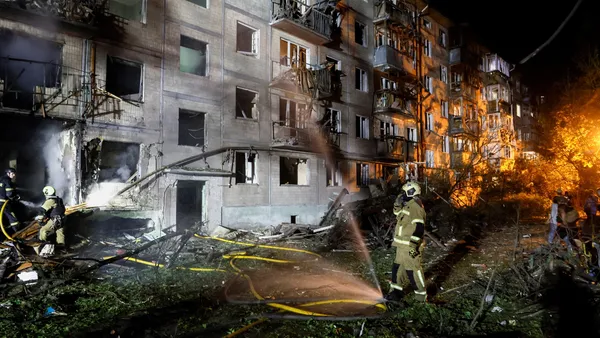
Missile Strikes and Civilian Casualties in Ukraine
Kyiv, Ukraine – Russia intensified its military aggression against Ukraine on Tuesday, unleashing a barrage of missiles, drones, and glide bombs across various cities, resulting in at least ten civilian deaths. The attacks occurred simultaneous to revelations from Ukrainian President Volodymyr Zelenskyy regarding new military support from North Korea aiding Russia in its prolonged offensive that has unfolded over more than four years.
Reports detail that a series of ballistic missiles supplied by North Korea targeted the southeastern city of Zaporizhzhia overnight. In this attack, seven workers at a steel plant were killed, and at least 21 others sustained injuries. Meanwhile, three additional victims, including a 15-year-old boy, lost their lives due to Russian drone and artillery attacks in the central Dnipropetrovsk region, according to local authorities.
Escalating Military Collaborations
President Zelenskyy shared insights regarding escalating military preparations, indicating that North Korea is preparing to send more troops to bolster Russian forces. He emphasized the recently signed strategic partnership between Russia and North Korea, established in 2024, which assures mutual support in cases of conflict. Expert analyses suggest that this partnership is likely enhancing North Korea's military capabilities and could provide it with valuable battlefield experience detrimental to other regional nations.
As Russia ramps up production of ballistic missiles, the Ukrainian government has voiced concerns regarding the critical shortage of Patriot air defense interceptors, allowing for significant potential damage during the forthcoming winter months. Zelenskyy stated on social media, “Every step Russia takes — increasing ballistic missile production, bringing in North Korean equipment, preparing for mobilization — all of this shows that Moscow is preparing not for peace, but for escalation.”
Russia’s Strategic Strikes on Kyiv and Zaporizhzhia
In an unexpected turn of events, the Ukrainian Air Force withheld specifics on the number of missiles launched by Russia overnight, raising questions about the omission. This absence of detail coincides with a broader U.S.-led diplomatic initiative faltering as Washington shifts focus toward other conflicts, notably the ongoing situation in Iran.
Simultaneously, airstrikes impacted various locations in the capital, Kyiv, including the grounds of a children's hospital, creating substantial damage but, fortunately, no injuries as children and medical personnel were sheltered safely. Additionally, a Russian strike ignited a fire in a warehouse, further exemplifying the widespread effects of the bombardments.
The International Response to Ongoing Aggression
The Russian Defense Ministry claimed responsibility for targeting military industrial zones and logistics facilities in Kyiv and Zaporizhzhia, asserting the strikes aimed at “ground-based precision weapons.” As the Russian offensive intensifies, Ukraine's General Staff reported countermeasures, highlighting strikes on an oil refinery in Orenburg, Russia, approximately 930 miles from the eastern Ukrainian front.
As international discourse concerning the ongoing conflict continues, the United Nations disclosed troubling estimates indicating that over 16,000 civilians are currently detained by Russian forces. U.N. Assistant Secretary-General for Human Rights, Claudia Fuentes Julio, condemned the systemic ill-treatment and torture of civilian detainees, including allegations of sexual violence.
In light of the escalation in military operations and ongoing human rights concerns, the potential for negotiations remains dim, with experts suggesting Moscow's military endeavors could severely undermine future diplomatic resolutions. The dynamics of the conflict will play a crucial role as both governments brace for what lie ahead.
As of now, the situation remains fluid, with investigations ongoing into the attacks and international responses being closely monitored.
📰 Related Stories
- Jacksonville City Council Enacts $2.03B FY 2027 Budget Preserving Affordable Housing as JTA Oversight Deepens Jacksonville • Sep 29, 2026
- Morgan Stanley Selects Downtown Dallas for $684 Million Regional Hub as $409M Bank of America Plaza Overhaul Advances Dallas • Sep 29, 2026
- San Diego MTS and Affirmed Housing Break Ground on $116M Spring View TOD as Airport Express Bus Expands San Diego • Sep 29, 2026
- Mayor Parker Reaches Halfway Mark with 16,000 Homes Under H.O.M.E. Plan as SEPTA Secures $80M Trolley Grant Philadelphia • Sep 29, 2026