Flooding Prompts Mass Evacuations Across Washington State
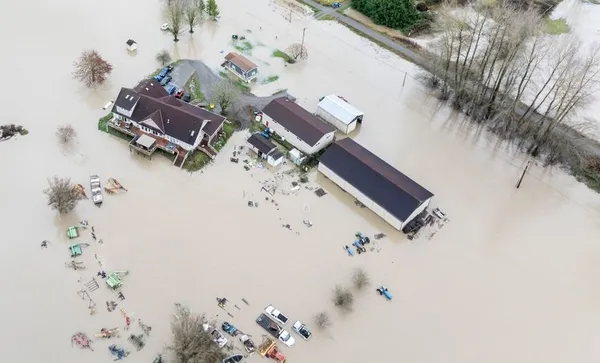
Widespread Evacuations Ordered After Days of Heavy Rain
Tens of thousands of Washington residents were under evacuation orders on Thursday after days of heavy rain triggered flooding that overflowed rivers, caused mudslides onto highways, and trapped people in floodwaters across the state.
Washington Gov. Bob Ferguson declared a statewide emergency on Wednesday and said at a news briefing on Thursday that flooding levels could be historic. Ferguson stated that lives would be at stake in the coming days and described the situation as extremely unpredictable.
Skagit River Floodplain and Northern Communities Affected
Skagit County, a major agricultural region north of Seattle, ordered all residents within the Skagit River floodplain to evacuate. According to county emergency management chief Julie de Losada, approximately 78,000 people live in that floodplain. An aerial view on Thursday, December 11, 2025, showed homes surrounded by floodwaters from the Skagit River near Lyman, Washington.
Along the Skagit River in Mount Vernon, teams went door to door in low-lying areas on Thursday to inform residents of evacuation notices, according to city authorities. The Skagit River was expected to crest at roughly 39 feet in Mount Vernon early Friday, a level officials described as a record flood. Mount Vernon Mayor Peter Donovan said the city was preparing for that crest and that officials were visiting low-lying residential neighborhoods to reach people who had not yet responded to evacuation notices.
The county closed nonessential government services on Thursday, including all district and superior court services. Flooding from the Skagit River has previously displaced hundreds of people in Mount Vernon, and the city completed a floodwall in 2018 to help protect its downtown area.
Rescues and Infrastructure Impacts Across Western Washington
Firefighters rescued several people from their homes in Sumas, a community near the U.S.–Canada border, according to Mayor Bruce Bosch. In Pierce County, sheriff's deputies rescued people at an RV park in Orting on Wednesday, including helping one man wade through waist-deep water. Part of Orting was ordered to evacuate over concerns about extremely high levels on the Puyallup River and issues with upstream levees. By Thursday, Pierce County officials reported conducting more than 25 rescues.
In Monroe, northeast of Seattle, floodwaters submerged homes in a mobile home park, including the residence of seven-year-old Jocelyn Rosas and her family, who had moved there about two months earlier. Her father, Jose Rosas, said the family had relocated to save money for his wife's cancer treatment and that their home was now gone.
Heavy rain also affected transportation infrastructure. A landslide blocked part of Interstate 90 east of Seattle, where photos from Eastside Fire & Rescue showed vehicles trapped by tree trunks, branches, mud, and standing water. Officials closed a mountainous section of U.S. Highway 2 due to rocks, trees, and mud on the roadway. Amtrak suspended train service between Seattle and Vancouver because of the conditions.
Rivers Reach or Approach Historic Levels
The National Water Prediction Service forecast 18 major floods and 15 moderate floods across Washington, according to the governor. The Skykomish River, about an hour northeast of Seattle, crested at 24 feet, reaching its highest level since 2006 and standing nine feet above flood stage.
Harrison Rademacher, a meteorologist with the National Weather Service in Seattle, described the weather pattern as an atmospheric river, calling it a jet stream of moisture stretching across the Pacific Ocean with its core directed along the coasts of Oregon and Washington. Rainfall intensity increased in several counties in the Cascade Mountains, where up to 6 inches of rain fell in 24 hours. At Snoqualmie Pass, the National Weather Service recorded an additional 1.7 inches of rain in six hours.
More than 11,000 electricity customers in Washington had lost power by Thursday night, according to PowerOutage.us. Ferguson said that hundreds of Washington National Guard members would be sent to assist communities, according to Gent Welsh, adjutant general of the Washington National Guard. Ferguson also stated that, even after floodwaters recede, Washington residents face a long and difficult recovery.
Ongoing Threat and Additional Storms Expected
State officials warned that, despite a lower-than-expected high-water mark upstream near the town of Concrete, record flood levels remained possible in other areas as water moved downstream. Robert Ezelle, director of the Washington Military Department's emergency management division, said that as river waters traveled downstream, they would gain strength.
Ferguson said on Wednesday night that catastrophic flooding was likely in many areas and that the state was requesting water rescue teams and boats. Rademacher said another storm system was expected to bring more rain starting Sunday and that the weather pattern looked unsettled leading up to the holidays.
📰 Related Stories
- Longview Paper Mill Tank Failure Followed Warnings That Vessel Was Unsafe Longview • Aug 28, 2026
- Pete Crow-Armstrong Powers Cubs’ Leadoff Attack in Seattle Seattle • Aug 23, 2026
- Seattle Balk Call Sparks Cubs Protest in Extra-Inning Loss to Mariners Seattle • Aug 22, 2026
- Chicago Communities Push Back Against Proposed White Sox Stadium Move to South Loop Chicago • Sep 09, 2026