LA Metro Reaches Operational Readiness on $3.1 Billion D Line Subway Extension Section 1 to Beverly Hills
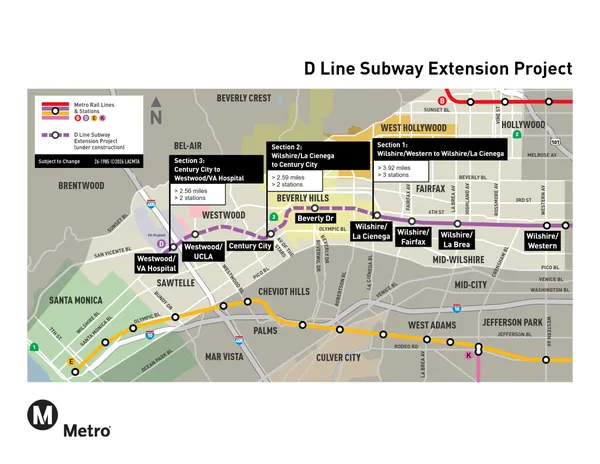
High-Capacity Underground Link Connects Downtown LA to Miracle Mile
LOS ANGELES, California — Marking the most significant rapid transit breakthrough for Southern California in decades, the Los Angeles County Metropolitan Transportation Authority (LA Metro) has achieved major operational readiness milestones on the $3.15 billion D Line (Purple Line) Subway Extension Section 1. The landmark 3.9-mile heavy-rail underground alignment extends west from Koreatown beneath the historic Wilshire Boulevard commercial corridor, directly linking Downtown Los Angeles with the Miracle Mile and the border of Beverly Hills.
Constructed by the Skanska-Traylor-Shea (STS) joint venture under the supervision of Metro engineering teams, Section 1 represents the critical initial phase of the broader $9.3 billion, 9-mile subway project. By extending subterranean transit deep into the heart of the Westside, the system establishes a rapid alternative to notoriously congested surface thoroughfares, providing reliable, high-capacity urban mobility ahead of the 2028 Los Angeles Olympic and Paralympic Games.
Three Landmark Stations Designed with Advanced Subterranean Engineering
Section 1 introduces three architecturally striking, multi-level underground stations engineered to process tens of thousands of daily commuters:
- Wilshire/La Brea Station: Anchors the eastern end of the extension, offering seamless multi-modal connections to dense residential, retail, and commercial developments along La Brea Avenue.
- Wilshire/Fairfax Station: Situated in the heart of Museum Row, providing direct underground access to world-renowned cultural institutions including the Los Angeles County Museum of Art (LACMA), the Academy Museum of Motion Pictures, the Petersen Automotive Museum, and the La Brea Tar Pits.
- Wilshire/La Cienega Station: Positioned at the edge of Beverly Hills, establishing a vital gateway for hospitality workers, business executives, and medical personnel visiting the La Cienega restaurant row and nearby healthcare complexes.
Cutting-Edge Seismic Safety and Methane Mitigation Technologies
Excavating through the complex subterranean geology of the Los Angeles Basin required pioneering civil engineering techniques. Tunneling teams deployed customized, pressurized Tunnel Boring Machines (TBMs) fitted with continuous gas detection systems to safely navigate pressurized tar and methane deposits native to the Salt Lake Oil Field.
Each station box features high-density water-impermeable concrete lining, robust seismic isolation joints capable of withstanding severe earthquake shaking, high-capacity ventilation shafts, and redundant fire suppression networks. Full ADA-compliant accessibility is delivered through dual glass elevator enclosures, tactile paving paths, and zero-clearance level platform interfaces.
Relieving Congestion Along California's Busiest Commercial Artery
Once integrated with the existing D Line and B Line (Red Line) trunk at Wilshire/Western and 7th Street/Metro Center, trains will whisk passengers between Downtown Los Angeles and the Miracle Mile in under 20 minutes—slashing peak-hour travel times by more than half compared to driving on surface streets.
With subsequent phases currently boring toward Century City and the UCLA campus in Westwood, the D Line Subway Extension forms the core spine of Los Angeles County's Twenty-Eight by '28 transit commitment, permanently transforming the mobility landscape of America's second-largest metropolitan area.
📰 Related Stories
- Mayor Karen Bass and Los Angeles City Council Direct $700M Toward Homelessness and Advance 510 New LAPD Officer Recruitments Los Angeles • Oct 18, 2026
- Mayor Karen Bass Launches 15-District Tour Across Los Angeles Highlighting Inside Safe Progress Amid Debate with Challenger Nithya Raman Los Angeles • Oct 18, 2026
- Fire Crews Contain Malibu Bryson Fire as Governor Newsom Proclaims Emergency and L.A. County Issues Cychlorphine Alert Los Angeles • Oct 18, 2026
- San Antonio City Council Evaluates Three Data Center Zoning Options as Planners Enforce Edwards Aquifer Protection San Antonio • Oct 18, 2026