South Australia Awards $180 Million Contract for Three Giant 15-Metre TBMs to Build $15.4 Billion Torrens to Darlington Tunnels in Adelaide
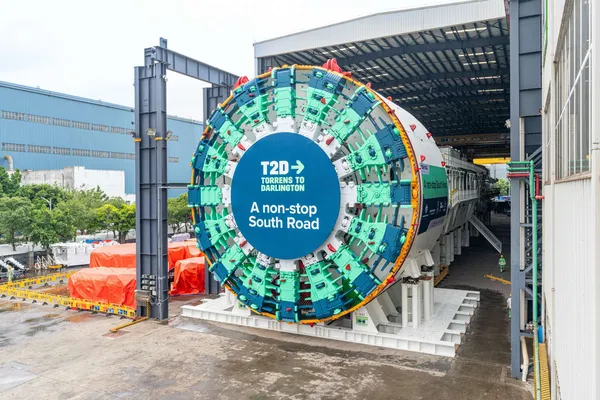
Procuring Southern Hemisphere's Largest TBM Fleet for Adelaide's Missing Freeway Link
ADELAIDE, South Australia — In the single largest infrastructure and civil engineering endeavor in South Australia's history, the South Australian Government and the Australian Federal Government, alongside the T2D Delivery Alliance, have finalized a monumental $180 million equipment procurement contract with premier German tunneling manufacturer Herrenknecht. The contract commissions three massive 15-metre diameter Earth Pressure Balance (EPB) Tunnel Boring Machines (TBMs) alongside two 4.1-metre cross-passage machines to excavate 10.5 kilometres of twin three-lane motorway tunnels across the landmark $15.4 billion River Torrens to Darlington (T2D) Project.
Delivered by the winning consortium comprising John Holland, Bouygues Construction, Arcadis Australia, Jacobs, and Ventia, the T2D project marks the final, defining link of the 78-kilometre North-South Corridor between Gawler and Old Noarlunga. The procurement of three primary mega-TBMs represents an innovative engineering strategy that allows both the northern and southern tunnel sections to be bored simultaneously, compressing overall delivery timelines by years.
TBMs Named 'Mary', 'Catherine', and 'Elizabeth' Honoring Trailblazing Women
Following an extensive statewide public nomination process celebrating pioneering South Australian history, the three mega-machines have been officially christened:
- TBM Mary: Named after suffragist and union pioneer Mary Lee, who was instrumental in South Australia becoming the first Australian colony to grant women the vote in 1894.
- TBM Catherine: Named after acclaimed journalist, novelist, and social reformer Catherine Helen Spence, Australia's first female political candidate.
- TBM Elizabeth: Named after temperance leader and women's rights advocate Elizabeth Webb Nicholls.
Measuring roughly 100 metres in length and weighing over 3,500 tonnes each, the colossal machines are engineered to navigate Adelaide's complex quaternary alluvial soils, heavy clays, and gravels at depths of up to 50 metres underground, minimizing ground settlement and protecting established heritage structures across Glandore, Torrensville, and Clovelly Park.
Eliminating 21 Traffic Lights and Slashes Commutes Across Greater Adelaide
Once operational, the T2D project will permanently transform vehicular mobility and freight logistics across metropolitan Adelaide. By shifting heavy commercial vehicles and long-distance commuter traffic into subterranean expressway tunnels, the bypass will eliminate 21 sets of surface-level traffic lights along congested South Road.
Travel times between the River Torrens and Darlington will be slashed by up to 30 to 40 minutes during morning and evening peak hours, offering free-flowing, reliable transport for over 130,000 vehicles every day. Freight operators will experience substantial reductions in transit times and operational costs between Port Adelaide, Adelaide Airport, the Tonsley Innovation District, and export agricultural regions in the Fleurieu Peninsula.
Generational Job Creation, Apprenticeships, and 100,000m² of Urban Parkland
South Australian Premier and infrastructure leadership underscored that the $15.4 billion program is driving an economic renaissance across the state. The project supports more than 5,500 direct and indirect construction jobs annually throughout its delivery lifecycle, incorporating strict mandates for South Australian local industry participation, civil apprenticeships, cadetships, and Aboriginal workforce engagement.
At the surface level, the diversion of highway traffic underground unlocks over 100,000 square metres of brand-new public open space, indigenous botanical gardens, shaded walking paths, and grade-separated cycling superhighways along the revived South Road corridor. High-efficiency transverse tunnel ventilation systems and regenerative LED illumination will be deployed, delivering a sustainable, resilient transport spine designed to serve South Australia for the next century.
📰 Related Stories
- South Australia Accelerates $15.4B Torrens to Darlington Tunnels and New Women's and Children's Hospital in Adelaide Adelaide • Oct 24, 2026
- South Australia Advances $15.4 Billion Torrens to Darlington Project as T2D Alliance Prepares Triple TBM Fleet Adelaide • Oct 13, 2026
- South Australia Accelerates $15.4 Billion River Torrens to Darlington Motorway Project with Tunnel Boring Deployment Adelaide • Oct 06, 2026
- Western Australia Unveils METRONET Morley-Ellenbrook Rail Line and Deploys Locally Built C-Series Railcars Perth • Oct 23, 2026