Prague Accelerates Construction of €2.1 Billion Driverless Metro Line D Uniting Southern Suburbs with City Centre
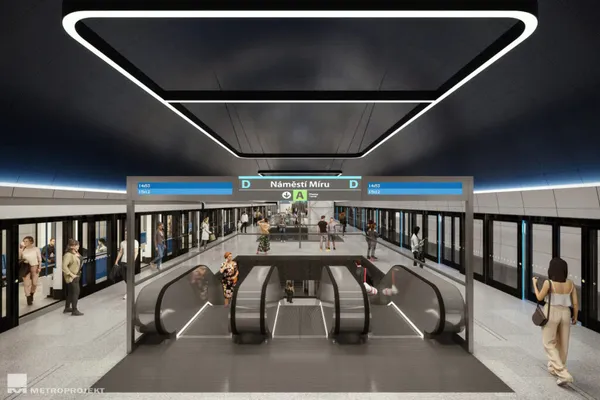
Transforming Bohemian Mass Transit with Prague's First Automated Subway Line
PRAGUE, Czech Republic — In the most ambitious civil infrastructure and public transportation development undertaken in the Czech Republic in four decades, the City of Prague (Hlavní město Praha) and municipal transit authority Dopravní podnik hl. m. Prahy (DPP) have reached peak subterranean construction across the landmark €2.1 billion (CZK 52 billion) Metro Line D (Blue Line). Spanning 10.6 kilometres of newly engineered underground heavy rail and 10 modern stations from Náměstí Míru in Vinohrady through Pankrác to Depo Písnice in the south, Line D marks Prague’s first-ever fully automated, driverless rapid transit corridor.
Designed to resolve chronic road congestion and overcrowded bus networks that have bottlenecked southern Prague for generations, the Blue Line establishes high-capacity rapid transit for major suburban communities, healthcare complexes, and business parks. Once operational, Metro Line D will transport more than 150,000 daily passengers, slashing commute times between the southern periphery and central Prague by up to 25 minutes while integrating directly with existing Metro Lines A and C.
Complex Subterranean Excavations and Deep Rock Caverns at Pankrác and Olbrachtova
Civil engineering joint ventures—including prominent constructors Subterra, Metrostav, and Hochtief CZ—are executing complex underground rock mining along the primary 1.2-kilometre section between Pankrác D and Olbrachtova. Working at depths exceeding 33 metres beneath dense residential quarters and active highway overpasses, tunneling teams deploy advanced New Austrian Tunnelling Method (NATM) techniques, using robotic drill rigs, targeted controlled blasting, and fiber-reinforced shotcrete to carve cavernous station vaults out of solid ordovician shale and sandstone.
At Pankrác D, engineers are constructing an intricate, multi-level subterranean transfer interchange directly beneath the existing Line C station. To construct the connecting passenger concourses without disrupting the hundreds of thousands of daily commuters riding Line C, specialized micropile foundation curtains and continuous electronic displacement sensors monitor ground movements to millimeter precision, setting a new benchmark for delicate urban tunneling in Central Europe.
Unattended GoA4 Driverless Trainsets and Synchronized Platform Screen Doors
Metro Line D is engineered from the ground up as a showcase of digital railway automation, operating with state-of-the-art Grade of Automation 4 (GoA4) unattended driverless technology. Governed by advanced Communications-Based Train Control (CBTC) digital signaling, the system allows autonomous trains to communicate in real time, permitting headways of just 90 seconds during peak morning and evening rush hours.
For the first time in Prague's 50-year metro history, every station along Line D will feature full-height, reinforced glass Platform Screen Doors (PSDs) along platform edges. Synchronizing automatically with the train doors upon stopping, the screen doors completely eliminate track falls and unauthorized track incursions, while dramatically improving underground ventilation efficiency, thermal control, and acoustic dampening across passenger waiting areas.
Architectural Excellence, Public Art Contests, and Environmental Decarbonization
Embracing Prague's rich artistic traditions, the City of Prague and DPP organized prestigious international architectural and artistic competitions to design each station on Line D. Leading Czech artists and designers have crafted bespoke aesthetic identities for each stop—from kinetic lighting installations to glass mosaics and ceramic wall reliefs—transforming the underground corridor into a subterranean public gallery.
Civic leaders, environmental ministers, and transport planners emphasized that Metro Line D serves as the fundamental catalyst for Prague's Climate Plan 2030. By shifting an estimated tens of thousands of daily car journeys onto clean, electrified heavy rail, the line will eliminate thousands of tonnes of carbon dioxide and particulate matter annually. Supported by park-and-ride commuter garages for over 3,000 vehicles and direct interchanges with regional suburban buses at Písnice and Krč, Metro Line D establishes a durable, eco-friendly transit backbone that will serve Prague for the next century.
📰 Related Stories
- Former NFL Coach Rex Ryan Faces Charges in Nashville Pedestrian Incident as Oracle Displays Campus Models Nashville • Nov 12, 2026
- Oklahoma City Council Extends Large Data Center Moratorium Through 2027 to Protect Grid and Assess Zoning Oklahoma City • Nov 12, 2026
- Denver Hosts Major National Post-Midterm Conference as City Launches Search for New 911 Chief Denver • Nov 12, 2026
- Seattle Council Debates Police Surveillance Camera Expansion as City Recovers $133K in Hotel Labor Settlement Seattle • Nov 12, 2026