Nexus Deploys Landmark £362 Million Stadler Class 555 Train Fleet into Full Passenger Service Across Tyne and Wear Metro
A Generational Modernization for North East England's Iconic Transit Grid
NEWCASTLE UPON TYNE, Tyne and Wear — In a transformative milestone for public mass transit, passenger comfort, and sustainable regional connectivity across North East England, transport executive Nexus and Swiss train manufacturer Stadler Rail have reached peak deployment across the monumental £362 million Tyne and Wear Metro fleet renewal programme. The landmark initiative introduces a brand-new, custom-built fleet of 46 Stadler Class 555 electric trains, systematically replacing the network’s original 1980s Metrocars that have faithfully served the 77-kilometre regional rail network for more than four decades.
Jointly backed by substantial capital grant funding from the Department for Transport (DfT) alongside regional contributions managed through the North East Combined Authority, the delivery of the high-tech Swiss train fleet represents the largest single investment in the Metro system since its original opening. The modern fleet provides transformed service reliability, higher capacity, and world-class accessibility for more than 30 million annual passenger journeys across Newcastle, Gateshead, Sunderland, North Tyneside, and South Tyneside.
Revolutionary Automatic Sliding Steps and Onboard Traction Batteries
The five-car articulated Class 555 trainsets are engineered with cutting-edge accessibility features, highlighted by intelligent automatic sliding steps fitted at every passenger doorway. As the train pulls into any of the network’s 60 stations, the automated step extends outward flush to the platform edge, completely closing the platform gap to provide effortless, unassisted level boarding for wheelchair users, mobility scooters, pushchairs, and passengers with heavy luggage.
In an engineering breakthrough for British urban rail, the trains incorporate onboard energy storage traction batteries. In the event of an overhead catenary power outage or emergency track de-energization, the train can seamlessly tap its onboard battery packs to operate autonomously over several kilometres, safely transporting passengers to the nearest station without being stranded in subterranean tunnels or on bridges crossing the River Tyne.
Spacious Open Gangways, Air Conditioning, and Passenger-Centric Design
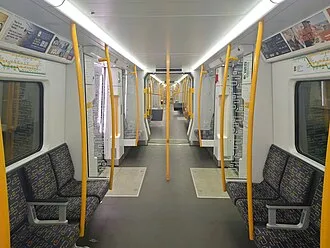
Designed following extensive public consultation that incorporated direct feedback from over 23,000 passengers and regional disability advocacy groups, the Class 555 trains deliver an expansive, turn-up-and-go travel experience. The carriages feature continuous, open walk-through gangways from end to end, maximizing standing space and passenger circulation while fostering a secure, open atmosphere.
The interior introduces linear seating upholstered in high-durability moquette fabrics, dedicated multi-use bays for wheelchairs, bicycles, and luggage, and energy-efficient modern climate-control air conditioning tailored to regional weather. Passengers benefit from illuminated digital destination screens, real-time audio-visual stop announcements, integrated USB mobile charging ports at seats, and an advanced security system featuring 44 high-definition digital CCTV cameras per trainset.
Powered by New £70M Gosforth Depot and Driving Net-Zero Carbon Goals
Supporting the introduction of the Class 555 fleet is Nexus's newly completed £70 million state-of-the-art Gosforth Depot, constructed by civil engineering contractor VolkerStevin. Featuring specialized crane-lift maintenance bays, computerized wheel lathes, automated inspection pits, and high-efficiency train wash facilities, the modernized facility secures high-skilled engineering and technical jobs in Newcastle for decades to come.
From an ecological standpoint, the new fleet delivers a dramatic environmental upgrade. Engineered with high-efficiency regenerative braking technology, the trains feed up to 30 percent of their braking energy directly back into the overhead catenary wire, significantly curbing power consumption across the system. By encouraging modal shift away from congested highways such as the A1, A19, and the Tyne Bridge, the new Metro fleet plays an indispensable role in advancing North East England’s statutory climate transition and clean air mandates.
📰 Related Stories
- Nexus Accelerates £362 Million Stadler Class 555 Fleet Rollout Across Tyne and Wear Metro Network Newcastle Upon Tyne • Oct 06, 2026
- Nexus Accelerates Network Rollout of £362 Million Stadler Class 555 Train Fleet Across Tyne and Wear Metro Newcastle Upon Tyne • Oct 05, 2026
- Nexus and Stadler Complete Delivery of £362 Million Class 555 Train Fleet as Tyne and Wear Metro Advances Network-Wide Transition to Modern Rapid Transit Newcastle Upon Tyne • Oct 03, 2026
- Brutal Attack in Newcastle as Robbery Victim’s Partner Assaulted with Machete Amid Efforts to Drop Charges Newcastle Upon Tyne • Jun 05, 2025