Los Angeles Metro Opens Section 1 of Landmark D Line Subway Extension Connecting Koreatown to Miracle Mile and Beverly Hills
Transforming Transit Along the Busiest Arterial Corridor in Southern California
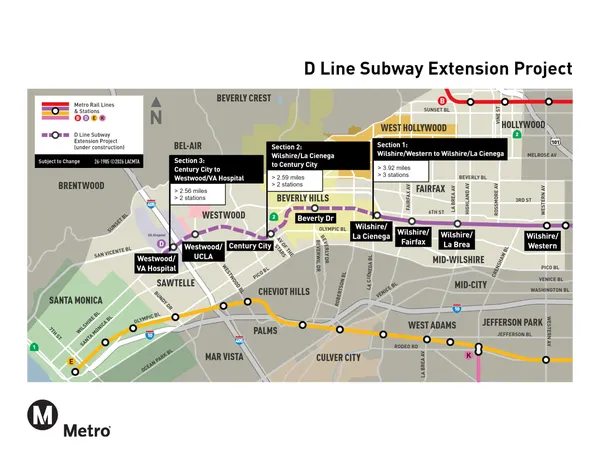
LOS ANGELES, California — Marking one of the most consequential transit milestones in modern Southern California history, the Los Angeles County Metropolitan Transportation Authority (Metro) has officially opened Section 1 of the landmark $9.5 billion D Line (formerly Purple Line) Subway Extension. Extending nearly four miles westward from the former terminus at Wilshire/Western through Koreatown, the Miracle Mile, and into the border of Beverly Hills, the grade-separated heavy rail megaproject introduces a rapid, traffic-free transit alternative beneath Wilshire Boulevard—historically one of the most gridlocked surface commercial arteries in the United States.
With passenger service now in full operation, the extension provides high-speed, direct rail connections between Downtown Los Angeles and Mid-Wilshire in just under 20 minutes. Commuters, cultural visitors, and healthcare workers traveling between 7th Street/Metro Center and the new western terminus experience predictable, high-capacity transit that slashes travel times by more than half compared to peak-hour automobile congestion on the surface street network.
Three Landmark Subterranean Stations Anchoring Major Cultural and Civic Hubs
Section 1 of the D Line subway extension introduces three brand-new, architecturally striking underground stations: Wilshire/La Brea, Wilshire/Fairfax, and Wilshire/La Cienega. Engineered dozens of feet below ground with soaring passenger concourses, heavy-duty escalators, high-capacity dual elevators, and step-free level boarding, each station is tailored to provide frictionless multimodal connectivity for tens of thousands of daily commuters.
The newly opened Wilshire/Fairfax station places riders directly at the doorstep of the city’s world-renowned Museum Row, granting car-free access to the Los Angeles County Museum of Art (LACMA), the Academy Museum of Motion Pictures, the Petersen Automotive Museum, and the historic La Brea Tar Pits. Complementing the architecture, each station precinct showcases monumental civic art installations curated from accomplished Southern California artists, celebrating the distinct cultural fabric of Los Angeles.
High-Capacity Heavy Rail Fleet and Next-Generation CBTC Signalling
Operations along the newly expanded corridor are driven by Metro’s expanding fleet of state-of-the-art CRRC HR4000 heavy rail vehicles. Capable of cruising speeds up to 70 miles per hour, the married-pair stainless steel trainsets feature open walkthrough gangways, dynamic interior route maps, wide automated entry doors, and dedicated bays for wheelchairs and bicycles.
Safety and service reliability are safeguarded by cutting-edge Communications-Based Train Control (CBTC) signalling architecture. Operating on encrypted digital radio loops, the computerized signalling system continuously regulates train speed curves and braking zones in real time, enabling tight, four-minute operating headways during morning and afternoon commute peaks while ensuring absolute fail-safe collision protection.
Accelerating Progress on Sections 2 and 3 Ahead of the 2028 Olympic Games
Metro executive leadership and civic authorities emphasized that the delivery of Section 1 marks a critical milestone within the broader Twenty-Eight by '28 transit infrastructure initiative, preparing the region for the 2028 Olympic and Paralympic Games. Heavy tunneling and station civil excavation remain on an accelerated trajectory across Section 2 (extending through Downtown Beverly Hills into Century City) and Section 3 (reaching Westwood/UCLA and the West Los Angeles VA Medical Center).
Once the full nine-mile alignment is completed to Westwood, riders will be able to journey from Downtown Los Angeles to the UCLA campus in roughly 30 minutes, creating a vital mobility spine that bridges commercial financial districts, world-class medical facilities, and premier academic centers for generations to come.
📰 Related Stories
- LA Metro Activates Free Countywide Transit for Clean Air Day as Southern California Navigates Record 104-Degree Autumn Heat Wave Los Angeles • Oct 06, 2026
- Mayor Bass Mobilizes Emergency El Niño Storm Defenses as LA Metro Prepares Free Clean Air Day Transit Los Angeles • Oct 06, 2026
- Los Angeles Approves Record $466M Measure ULA Affordable Housing Round as LA Metro Orders 220 Electric Buses Los Angeles • Oct 06, 2026
- VTA Achieves 3M Safe Hours on BART Phase II as San Jose Enforces Geographic Equity for 2,200 Interim Housing Units San Jose • Oct 06, 2026