Honolulu Skyline Accelerates Driverless Rail Expansion to Airport and Awards $1.66 Billion City Center Guideway Contract
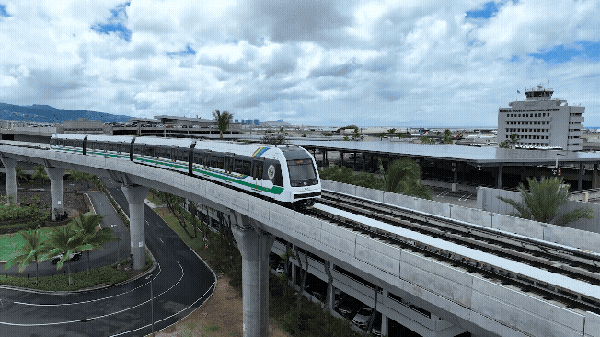
Milestone Expansion for America’s First Fully Automated Driverless Metro
HONOLULU, Hawaii — Marking a historic advancement for public mass transit in the Pacific, the Honolulu Authority for Rapid Transportation (HART) and the City and County of Honolulu’s Department of Transportation Services (DTS) have celebrated the milestone operational rollout of Segment 2 of Skyline, the nation’s first fully automated, driverless light metro rail system. The vital 5.3-mile expansion extends passenger service eastward from Aloha Stadium through Joint Base Pearl Harbor-Hickam directly to Daniel K. Inouye International Airport (HNL) and the Kahauiki / Kalihi Transit Center, connecting West Oahu commuters to the island's premier economic and aviation gateway.
First opened along its initial suburban alignment between East Kapolei (Kualakaʻi) and Aloha Stadium (Hālawa), the Skyline system has transformed urban travel on Oahu's heavily congested Interstate H-1 corridor. With the commissioning of Segment 2, air travelers, airport hospitality staff, military personnel, and daily commuters can bypass highway gridlock entirely, completing journeys between western suburban communities and airport terminals in under 25 minutes aboard air-conditioned, zero-emission trains.
$1.66 Billion City Center Contract: Advancing the Guideway to Kakaʻako Civic Center
Building upon the operational success of the airport segment, HART has officially finalized the major $1.66 billion City Center Guideway and Stations (CCGS) contract with Tutor Perini Corporation. The crucial contract represents the final capital phase of the 18.9-mile transit corridor, encompassing the design and construction of three miles of elevated guideway and six state-of-the-art transit stations extending from Kalihi through Iwilei, Chinatown, downtown commercial corridors, and terminating at the Kaʻākaukukui / Civic Center station in Kakaʻako.
Funded by a mix of federal transit capital grants, state general excise tax surcharges, and local transient accommodations taxes (TAT), the City Center segment will connect Honolulu’s dense governmental, judicial, and cultural district with residential neighborhoods. Heavy utility relocations, column foundation drilling, and drilled shaft installations are advancing along Dillingham Boulevard and Nimitz Highway, paving the way for full revenue service to the Civic Center by 2031.
Hitachi Rail Driverless Fleet and Elevated Engineering Resilience
The Skyline system operates a specialized fleet of four-car driverless trainsets engineered by Hitachi Rail. Featuring continuous open gangways, regenerative braking, dynamic overhead passenger maps, and high-efficiency air conditioning systems designed for tropical marine environments, each train accommodates up to 800 passengers. Automated communication-based train control (CBTC) systems monitor headways and track safety, enabling trains to depart every 10 minutes during peak travel windows.
The entire alignment is carried on an elevated viaduct elevated between 30 and 40 feet above street level, safeguarding transit operations against localized sea-level rise, king tides, and urban flooding while eliminating any grade crossings with pedestrian and vehicular traffic. Station facilities incorporate escalators, multi-passenger elevators, solar photovoltaic canopies, and tap-and-go HOLO card fare gates integrated with DTS’s island-wide bus network (TheBus).
Decarbonizing Oahu and Fueling Transit-Oriented Redevelopment
Honolulu Mayor Rick Blangiardi and transit leaders emphasized that Skyline is the cornerstone of the island's Climate Action Plan to achieve net-zero greenhouse gas emissions by 2045. By displacing an estimated 40,000 passenger vehicle trips from Interstate H-1 and Nimitz Highway each day, the rail corridor prevents tens of thousands of metric tons of tailpipe emissions and petroleum consumption annually.
Furthermore, the City and County of Honolulu has adopted comprehensive Transit-Oriented Development (TOD) zoning overlays around stations such as Iwilei and Middle Street. These special districts incentivize affordable and workforce housing developments, pedestrian promenades, and mixed-use retail hubs, ensuring that Honolulu's long-term urban growth is anchored by convenient, clean, and equitable mass transit.
📰 Related Stories
- Honolulu Officials Warn of New Tropical Threat After Hurricane Lala Honolulu • Aug 21, 2026
- Hawaii Doctor Gerhardt Konig Convicted of Attempted Manslaughter After Oahu Trail Attack Honolulu • Apr 09, 2026
- Hawaii flooding batters O'ahu and Maui as recovery begins after weeks of heavy storms Honolulu • Mar 24, 2026
- Hurricane Lowell Nears Hawaii as Hurricane Warning Issued for Kauai County Lihue • Sep 08, 2026