Barcelona Inaugurates Landmark Avinguda Diagonal Tram Extension Connecting Glòries to Verdaguer with Catenary-Free Technology
Transforming Barcelona’s Iconic Avinguda Diagonal into a Sustainable Green Transit Corridor
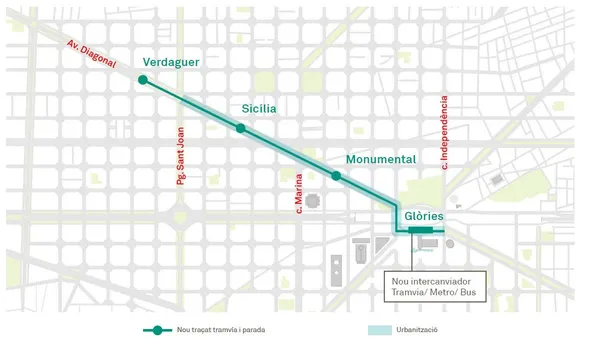
BARCELONA, Catalonia — In one of the most consequential urban mobility and ecological regeneration achievements in contemporary Catalan history, the Ajuntament de Barcelona (Barcelona City Council) and the Autoritat del Transport Metropolità (ATM) have officially inaugurated the landmark Avinguda Diagonal tram extension. Connecting the bustling multimodal interchange at Plaça de les Glòries with a brand-new terminus at Verdaguer, the project marks the historic first phase of the long-envisioned unification of the city’s two separate tram networks: Trambesòs and Trambaix.
Representing a combined municipal and metropolitan investment of over €63 million, the two-kilometre double-track alignment reclaims historic urban space from heavy private vehicular traffic. The newly configured central avenue features wide pedestrian boulevards paved with permeable stone, continuous segregated bicycle superhighways, and thousands of newly planted trees and Mediterranean shrubs, establishing a vibrant green lung directly through the heart of the Eixample district.
Spain's First Catenary-Free Tramway: Ground-Level Power Supply (APS) Technology
A defining technical breakthrough of the new Diagonal extension is its pioneering propulsion infrastructure. To protect Barcelona’s historic architectural heritage and maintain unobstructed sightlines toward Antoni Gaudí’s nearby masterpiece, the Basílica de la Sagrada Família, the line was engineered completely without overhead catenary cables or electrical contact wires. It is the very first operational tramway in Spain to deploy Alimentation Par le Sol (APS) ground-level power supply technology.
Under the APS system, modern low-floor Alstom Citadis trams draw electrical power from a continuous conductor rail embedded flush between the tracks. Power segments are activated only when fully covered by the chassis of the train, ensuring absolute electrical safety for crossing pedestrians, cyclists, and pets. Transitioning seamlessly from conventional overhead wires at Glòries to the catenary-free ground system along Diagonal occurs automatically on the move in mere seconds.
Three Brand-New Accessible Stations and Multi-Line Metro Interchanges
The newly commissioned alignment introduces three modern, fully accessible street-level tram stations: La Monumental, Sicília, and Verdaguer. Each station platform features level-boarding canopies, digital real-time timetable displays, integrated fare validation machines, and tactile paving for visually impaired commuters.
The new service enables a swift, traffic-free journey between Glòries and Verdaguer in just seven minutes, providing immediate step-free interchanges with four major Barcelona Metro lines (Line 1, Line 2, Line 4, and Line 5) as well as dozens of metropolitan bus lines. Transport planners estimate that the extension accommodates over 24,000 additional passenger journeys every day, eliminating more than 2,000 private vehicle trips daily from the congested central road grid.
Paving the Path Toward the Complete Trambaix-Trambesòs Unification
Mayor of Barcelona Jaume Collboni and regional transport leaders celebrated the opening as a triumph for clean air, public transit equity, and climate resilience. With political and budgetary approvals finalized for the subsequent phase extending the tramway from Verdaguer to Plaça Francesc Macià, Barcelona is poised to finalize the full 3.9-kilometre connection across the entirety of Avinguda Diagonal, uniting metropolitan municipalities from Badalona and Sant Adrià de Besòs to Cornellà and Sant Feliu de Llobregat into a world-class tram network.
📰 Related Stories
- Catalonia Advances Final Central Tunnel Excavation for 48-Kilometre Barcelona Metro Line 9 Network Barcelona • Sep 25, 2026
- James Paul Gracey Found Dead in Barcelona; Authorities Say Foul Play Unlikely Barcelona • Mar 22, 2026
- Body Found in Barcelona as Authorities Search for Missing University of Alabama Student James Paul Gracey Barcelona • Mar 20, 2026
- James Gracey Missing After Nightclub Visit in Barcelona Barcelona • Mar 19, 2026