Sound Transit Advances Historic 2 Line Light Rail Across Lake Washington Floating Bridge Linking Seattle and Bellevue
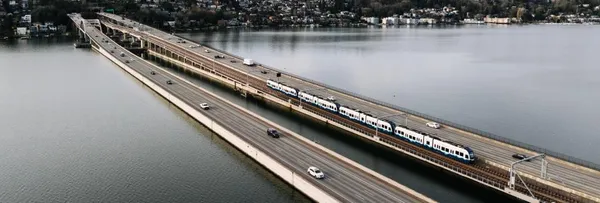
Pioneering the World's First Light Rail Transit Across a Floating Highway Bridge
SEATTLE, Washington — In a monumental achievement for civil transit engineering and regional connectivity across the Pacific Northwest, Sound Transit has entered the final integrated systems commissioning and simulated passenger service phase for the historic 2 Line (East Link) Crosslake Connection. Traversing the Homer M. Hadley Memorial Floating Bridge along the Interstate 90 corridor over Lake Washington, the project establishes the world's first operational high-capacity electric light rail transit line built directly atop a floating pontoon structure, uniting the tech hubs of Bellevue and Redmond with Downtown Seattle.
Engineered to solve one of the most notoriously congested aquatic choke points in North America, the cross-lake link completes the crucial missing segment of the 14-mile East Link light rail extension. Supported by voter-approved Sound Transit regional transit ballot measures and Federal Transit Administration (FTA) capital grants, the line establishes a lightning-fast, 20-minute traffic-free trip between downtown Bellevue and Seattle's International District/Chinatown, completely bypassing gridlock along Interstate 90 and the State Route 520 floating bridge.
Breakthrough Civil Engineering: Curved Track Bridges and Seismic Expansion Joints
Operating high-speed electric passenger trains over deep water presented unprecedented structural engineering challenges. Because floating bridge pontoons continuously shift, twist, and flex due to wind, water currents, lake level fluctuations of up to two feet, and seasonal thermal expansion, rigid conventional railway tracks could not be deployed. Sound Transit partnered with international bridge and seismic engineering specialists to design custom Track Bridge assemblies at both ends of the floating span.
These massive, precision-machined curved transition joints allow the continuous welded rail to articulate seamlessly in eight distinct directions—absorbing pitch, roll, yaw, and longitudinal expansion while maintaining rigorous track gauge tolerances. Specialized non-conductive stray current mitigation networks, composite fiberglass ties, and lightweight overhead catenary contact wires were custom-engineered to withstand heavy maritime wind shears and seismic forces without transferring destructive stresses into the floating pontoons.
Key Transit Nodes: Mercer Island and Judkins Park Stations
The cross-lake alignment incorporates two landmark multimodal passenger stations: Mercer Island Station and Judkins Park Station in central Seattle. Mercer Island Station, recessed within the central highway median, features dedicated bus-rail transfer bays, secure weather-protected bike enclosures, and comprehensive park-and-ride facilities, giving island residents instantaneous mass transit access to both sides of the lake.
In Seattle's Central District, Judkins Park Station establishes a vital new transit portal equipped with step-free glass elevator banks, public gathering plazas, and direct connections to regional bicycle greenways along the Mountains to Sound Greenway trail. From Judkins Park, 2 Line trains merge into the subterranean Downtown Seattle Transit Tunnel (DSTT), seamlessly connecting riders into Pioneer Square, Symphony, Westlake, and northward through Capitol Hill and the University of Washington toward Lynnwood.
Accelerating Regional Decarbonization and Sustainable Economic Prosperity
Puget Sound civic leaders, regional mayors, and Sound Transit leadership underscored that the 2 Line Crosslake Connection serves as the central circulatory artery of the Puget Sound economy. By doubling train service frequencies through the central Seattle transit tunnel and displacing tens of thousands of daily single-occupancy automobile trips, the zero-emission electric rail link prevents tens of thousands of metric tons of greenhouse gas emissions annually, anchoring sustainable growth across the Seattle metropolitan corridor for generations to come.
📰 Related Stories
- Seattle Completes Major 12th & Pike Overhaul on Capitol Hill as City Sets 2027 Minimum Wage at $22.14 Seattle • Oct 05, 2026
- Seattle Police Chief Shon Barnes Resigns as Mayor Wilson Launches Public Safety Transition Plan Seattle • Oct 05, 2026
- Seattle City Council Reviews Mayor Wilson’s $9.1B Biennial Budget as Sound Transit Evaluates Rail Phasing Seattle • Oct 05, 2026
- Sun Metro Expands Transit Frequency and Eastside Microtransit as Loop 375 Border Upgrades Move Ahead El Paso • Oct 05, 2026