MTA Advances $3.18 Billion Penn Station Access Megaproject with Four New Metro-North Stations Across the East Bronx
Transforming East Bronx Commutes with Direct West Side Manhattan Rail Access
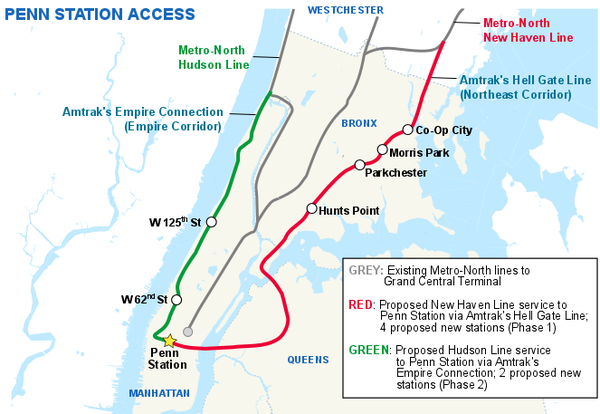
NEW YORK CITY, New York — In one of the most consequential transit equity initiatives in modern New York history, the Metropolitan Transportation Authority (MTA) is accelerating construction on the monumental $3.18 billion Penn Station Access project. The transformative infrastructure initiative will bring Metro-North Railroad passenger rail service directly to the East Bronx for the first time, leveraging Amtrak’s historic Hell Gate Line to provide seamless, one-seat rail rides directly into Penn Station on Manhattan’s West Side.
Currently, East Bronx residents traveling to Midtown Manhattan face grueling two-fare commutes on crowded subway lines and local buses that often exceed 75 minutes. Once operational, Penn Station Access will slash travel times dramatically, allowing commuters from Co-op City to reach Penn Station in just 25 minutes, saving over 50 minutes each way and unlocking vast economic opportunities across the metropolitan region.
Four State-of-the-Art, Fully Accessible Passenger Stations
The core of the capital project centers on constructing four brand-new, fully ADA-accessible passenger stations strategically located across the East Bronx: Hunts Point, Parkchester/Van Nest, Morris Park, and Co-op City. Each station is designed with dual high-level platforms, glass elevator enclosures, heated waiting shelters, digital real-time arrival screens, and bicycle parking amenities.
The Morris Park station will directly serve the bustling East Bronx medical hub, providing rapid transit connections for thousands of healthcare workers and patients traveling to Montefiore Medical Center, Jacobi Hospital, and the Albert Einstein College of Medicine. At Co-op City, home to more than 40,000 residents in the world's largest cooperative housing development, the new station introduces true regional rail connectivity to a long-isolated neighborhood.
Comprehensive Civil Engineering and Rail Corridor Modernization
Delivered under a design-build framework with a consortium led by Halmar International and RailWorks, the heavy civil engineering scope extends far beyond platform construction. Crews are completely modernizing 19 miles of the active Hell Gate Line rail corridor, including the installation of over 40 miles of new continuous welded track, advanced overhead catenary wiring, and new traction power substations.
Major structural rehabilitations are also underway across four historic rail bridges: the Bronx River Bridge, Bronxdale Avenue Bridge, Eastchester Road Bridge, and Pelham Lane Bridge. The recent commissioning of the modernized Leggett Interlocking in the South Bronx marks a vital systems milestone, enabling Metro-North and Amtrak dispatchers to safely integrate regional commuter trains alongside high-speed Northeast Regional and Acela services.
Catalyzing Regional Transit Equity and Sustainable Growth
MTA Chair and CEO Janno Lieber emphasized that Penn Station Access represents the gold standard of sustainable transit expansion by maximizing existing rail assets rather than building cost-prohibitive greenfield tunnels. By attracting an estimated 30,000 daily riders out of personal automobiles and onto zero-emission electrified commuter trains, the project will curb highway congestion on the Bruckner and Cross Bronx expressways while advancing New York’s long-term climate and transit connectivity goals.
📰 Related Stories
- MTA Approves Monitor Point Redevelopment in Greenpoint as Historic NYC Rent Freeze Takes Effect New York City • Oct 05, 2026
- Mayor Mamdani Activates Fast-Track Affordable Housing in 12 Districts as NYCHA Closes $607M Nostrand Modernization New York City • Oct 05, 2026
- Amtrak and NJ Transit Adjust Penn Station Schedules for Portal North Bridge Cutover as NYCHA Secures $607M for Nostrand Houses New York City • Oct 05, 2026
- Detroit Advances $2.24B Renaissance Center Redevelopment Talks as City Scales Affordable Housing PILOT Detroit • Oct 05, 2026