NYC Expands 100 Gold Street Redevelopment to 4,000 Apartments as MTA Advances $800M Hudson Line Climate Defense
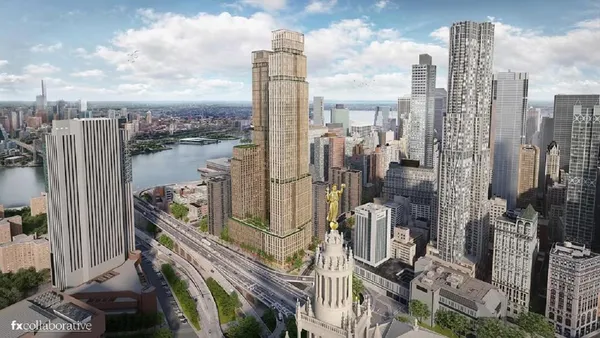
Downtown Manhattan 100 Gold Street Overhaul Scales to 4,000 Housing Units
NEW YORK, New York — Accelerating municipal efforts to unlock high-density residential opportunities across city-owned land, New York City development officials formally enlarged the planned redevelopment scope of the 100 Gold Street municipal property in Lower Manhattan in late September 2026. The revised master framework boosts total residential capacity by 8 percent, bringing the project to an unprecedented 4,000 mixed-income apartments as the development enters formal environmental impact reviews under the City Environmental Quality Review (CEQR) process.
The ambitious Lower Manhattan transformation aligns directly with the city’s landmark 'City of Yes for Housing Opportunity' framework and Mayor Zohran Mamdani's broader 'Block by Block' affordability strategy. The multi-tower plan dedicates substantial square footage to permanently rent-stabilized housing for working New Yorkers, while introducing modern civic infrastructure including a state-of-the-art public elementary school, community healthcare clinics, and neighborhood green spaces linking Fulton Street to the Civic Center.
MTA Mobilizes on $800 Million Hudson Line Coastal Surge Barrier
Simultaneously, the Metropolitan Transportation Authority (MTA) announced major engineering milestones on its $800 million climate resilience program safeguarding the Metro-North Railroad Hudson Line. Positioned directly alongside tidal stretches of the Hudson River, vulnerable rail tracks, signaling bungalows, and traction power substations are being fortified against severe sea-level rise and flash storm surges.
Engineers are installing specialized sheet-pile seawalls, rip-rap wave attenuators, and elevated power switchgear along low-lying embankments between Spuyten Duyvil and Croton-Harmon. Transit leadership reaffirmed that safeguarding regional commuter rail arteries is indispensable to sustaining economic mobility and housing growth across New York's metropolitan core.
Pioneering Resilient, Transit-Oriented Urban Communities
Urban planners and transit advocates emphasized that uniting large-scale, climate-resilient coastal infrastructure with high-volume residential density directly adjacent to subway and commuter rail hubs establishes the model for sustainable growth across the five boroughs. By pairing fortified transit lifelines with thousands of attainable homes, New York continues to secure its long-term civic vitality.
📰 Related Stories
- Gateway Hudson Tunnel Commences Subterranean Boring as NYC Advances 180-Acre Sunnyside Yard Master Plan New York City • Sep 29, 2026
- NYC Launches Public Review for 4,000-Home 100 Gold Street Redevelopment in Lower Manhattan as MTA Debuts Tremont Busway New York City • Sep 28, 2026
- Governor Hochul and MTA Award $19.7 Million Design Contract for Metro-North Hudson Line Climate Resiliency Along Bronx-Hudson Corridor New York City • Sep 26, 2026
- San Antonio Enacts $4.4 Billion FY 2027 Budget Securing Affordable Housing as VIA Green Line Rapid Transit Progresses San Antonio • Sep 30, 2026