MTA Advances 14-Mile Interborough Express Light Rail Project with Q4 Environmental Review and Brooklyn-Queens Hub Upgrades
Draft Environmental Review Scheduled Ahead of Time for 14-Mile Outer-Borough Line
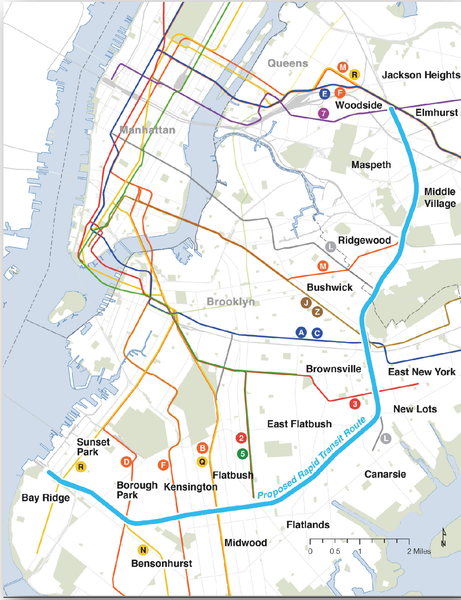
NEW YORK CITY, New York — The Metropolitan Transportation Authority (MTA) has confirmed key scheduling accelerations and design milestones for the landmark $5.5 billion Interborough Express (IBX) light rail project, announcing that the formal Draft Environmental Impact Statement (DEIS) will be delivered ahead of schedule in the fourth quarter of 2026. Connecting the Brooklyn Army Terminal in Bay Ridge directly to Roosevelt Avenue in Jackson Heights, Queens, the transformative 14-mile transit spine represents New York City's most consequential outer-borough rail expansion in more than half a century.
Operating primarily along the existing Bay Ridge freight rail corridor, the IBX will eliminate the historical requirement for outer-borough commuters to route through congested Manhattan hubs simply to travel between adjacent boroughs. Once fully operational, the line is projected to carry approximately 160,000 daily riders, slashing journey times for nearly 900,000 residents residing along the high-density transit corridor.
18 Accessible Stations and Seamless Multimodal Rail Connections
Spearheaded by the specialized engineering joint venture of Jacobs and HDR, the comprehensive preliminary design phase is establishing 18 fully accessible modern light rail stations along the alignment. The route introduces unmatched transit redundancy, establishing direct transfer interchanges with up to 17 New York City Subway lines, 51 local bus routes, and the Long Island Rail Road (LIRR).
MTA planners selected modern light rail transit over bus rapid transit and heavy rail due to its superior passenger capacity, tight curving geometry along the legacy rail corridor, and rapid acceleration capabilities. High-frequency operating timetables will feature headways of less than five minutes during peak rush periods, connecting Brooklyn's coastal industrial centres directly with Queens' premier commercial avenues.
Subway Interchange Upgrades and Accessibility Modernization Underway
In direct alignment with the IBX expansion, MTA Construction & Development has initiated capital modernization programs across four critical subway transfer hubs along the route. Civil engineering crews are actively advancing structural accessibility retrofits at Junius Street station on the 3 train, delivering an enclosed, climate-controlled transfer passageway directly connecting to the Livonia Avenue L train platform by the end of 2026.
Subsequent accessibility and passenger circulation overhauls are scheduled to progress through the massive Broadway Junction complex (connecting A, C, J, Z, and L trains) by late 2027, followed by comprehensive accessibility enhancements at Avenue I on the F line and Wilson Avenue on the L line between 2027 and 2028, guaranteeing universal, step-free access across the regional transit network.
Catalyzing Sustainable Economic Growth and Outer-Borough Equity
Civic and transportation leaders across Brooklyn and Queens underscored that the Interborough Express delivers transformative climate and economic benefits. By diverting hundreds of thousands of daily motorized trips from the heavily congested Brooklyn-Queens Expressway (BQE) and local residential arteries, the electric light rail service will significantly curb greenhouse gas emissions and particulate pollution in frontline environmental justice communities.
With the DEIS public comment phase scheduled to begin before the conclusion of 2026, the MTA is on track to advance final engineering contracts toward commercial construction, bringing New York City one step closer to launching revenue passenger service in the 2030s.
📰 Related Stories
- Governor Hochul and MTA Award $19.7 Million Design Contract for Metro-North Hudson Line Climate Resiliency Along Bronx-Hudson Corridor New York City • Sep 26, 2026
- MTA Expands Second Avenue Subway Contracts as Manhattan Congestion Relief Program Generates $15 Billion Capital Transit Pipeline New York City • Sep 26, 2026
- Governor Hochul Declares State of Emergency for NYC as Coastal Nor'easter Prompts MTA Bridge Restrictions and Flood Safeguards New York City • Sep 26, 2026
- NYC Council Unveils Sweeping AI Governance Legislation with Whistleblower Protections and Algorithmic Audits New York City • Sep 25, 2026