Chicago Executive Order Targets Contractors Linked to Corruption and ICE Practices
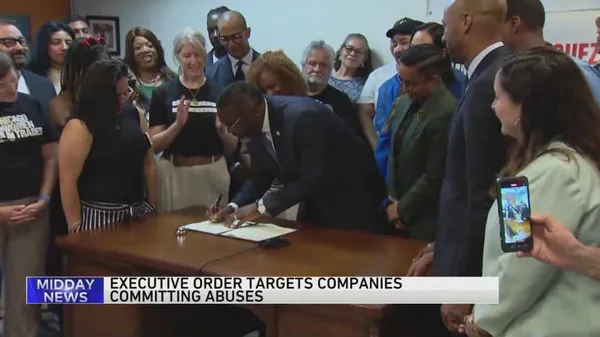
Johnson expands Chicago contractor scrutiny through executive action
CHICAGO, Illinois — Mayor Brandon Johnson signed an executive order Wednesday that could bar companies accused of corruption, workplace abuses or misconduct connected to government contracts from doing business with Chicago, while requiring vendors to disclose their ties to agencies including U.S. Immigration and Customs Enforcement.
The order creates a broader screen for city contractors and subcontractors, requiring them to certify that they have not committed a defined public-integrity violation during the previous five years and will not do so during the life of a city contract. It also establishes a 12-member Ethical Procurement Standards Task Force and directs the city’s chief procurement officer to develop penalties for companies that violate the new requirements.
Johnson framed the action as a response to what he called an unprecedented level of corporate corruption nationally and said the city should not spend taxpayer money with firms accused of undermining workers’ rights or other civil rights protections. In an interview with WBEZ, Johnson said his administration was acting amid heightened concerns about workers, voters and LGBTQ+ residents.
“All of us are incredibly vulnerable right now,” Johnson said. “I’m working to do something about it.”
New rules reach beyond criminal convictions
Chicago’s existing contracting rules already prohibit companies with certain criminal convictions, including convictions involving theft, deceit, bribery, hate crimes, perjury and treason. Johnson’s executive order adds a separate category of public-integrity violations that can disqualify a contractor even when the matter was not resolved in criminal court.
Under the new framework, a finding by a government watchdog, inspector general or auditor could be considered disqualifying. The order specifically addresses workplace discrimination, wage theft and other conduct defined as a public-integrity violation. However, offenses covered under existing city rules that are not included in the order’s expanded definition would continue to require a formal conviction before they can be used to disqualify a vendor.
Sheila Bedi, Johnson’s chief strategy officer, said the policy is intended to prevent the city from contracting with companies whose conduct may not result in criminal charges but still raises serious ethics concerns. She said Chicago does not want to support such firms with public dollars.
ICE disclosure requirement follows deportation-contract campaign
The executive order also requires contractors to disclose contracts they hold with other government bodies and law-enforcement agencies, including ICE. Those disclosures are to be made public. Companies must additionally report allegations involving excessive force, unlawful detention, unconstitutional policing or discrimination connected to their government work.
The measure was prompted in part by the “Not With Our Money” campaign, which urges local governments to use their contracting authority to pressure companies that assist militarized deportation efforts. Dorian Warren, a spokesperson for the campaign, said Chicago is the first city to act while discussions continue with officials in New York City, Newark and Minneapolis.
The campaign’s research estimates Chicago has $3.19 billion in contracts with companies that also do business with ICE. Its largest identified contract involves infrastructure consultant AECOM, which oversees modernization work at O’Hare International Airport. Bedi said the order is not designed to automatically exclude firms solely because they hold ICE contracts; instead, it requires transparency and can trigger further scrutiny over alleged misconduct.
Large companies seeking Chicago contracts will also face new diversity reporting obligations. Businesses with more than $1 billion in annual revenue must disclose the demographic makeup of their leadership and boards, along with policies intended to promote diversity. All contractors must report efforts to recruit, hire and promote formerly incarcerated people.
The order is Johnson’s sixth executive decree this year and the 26th of his administration, reflecting his continued use of executive authority as relations with parts of the City Council remain strained. City procurement officials must now develop enforcement procedures, while the new task force is expected to help shape ethical contracting standards.
📰 Related Stories
- Mayor Brandon Johnson Unveils 2027 Budget Engagement Report with UIC Ahead of Crucial City Council Fiscal Address Chicago • Oct 19, 2026
- Chicago Transit Authority Advances Historic $3.6 Billion Red Line Extension with $1.97 Billion Federal Grant Agreement Chicago • Oct 18, 2026
- Mayor Brandon Johnson Prepares 2027 Chicago Budget Address Following Council Debt Veto Win and Corporate Tax Push Chicago • Oct 18, 2026
- Chicago City Council Veto Override on Debt Threshold Falls One Vote Short as Aldermen Approve $260.8M Police Settlement Chicago • Oct 18, 2026