U.S. Gas Prices Surge Past $3.48 Per Gallon Amid Middle East Conflict and Strait of Hormuz Disruptions
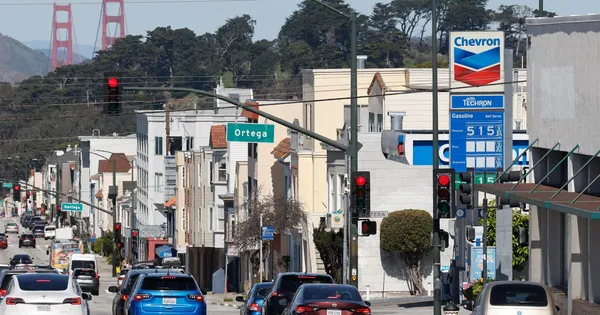
American motorists are feeling the weight of escalating fuel costs as gasoline prices climbed to a national average of $3.48 per gallon, marking a 48-cent increase within a single week and a 58-cent rise compared to one month prior. The surge follows a spike in global oil prices driven by military conflict involving the United States, Israel, and Iran, which temporarily pushed crude benchmarks above $100 per barrel for the first time since 2022.
At the height of Monday's volatility, both West Texas Intermediate and Brent crude approached $120 per barrel before retreating significantly. WTI ultimately settled near $94.77 before falling below $85, while Brent crude pulled back toward $95 after briefly settling at $98.96. Diesel prices also spiked sharply, rising nearly 89 cents over the past week to reach $4.66 per gallon. California recorded the highest state average at $5.20 per gallon, followed by Washington state at $4.63, while Kansas maintained the lowest average nationally at $2.92.
The central concern among energy analysts is the Strait of Hormuz, the critical maritime corridor linking the Persian Gulf to the Arabian Sea. Disruptions to tanker traffic through this chokepoint have rattled global energy markets. Analysts at one leading investment firm warned that crude prices could remain elevated — potentially exceeding $120 per barrel — until shipping security through the strait is restored.
While some analysts project the national average could approach $4 per gallon within days, a petroleum industry expert suggested prices may stabilize between $3.50 and $3.65 if oil markets continue to ease. President Trump characterized the price increases as short-term and indicated the administration has a strategy to maintain energy market stability, including a government-backed insurance program covering maritime vessels navigating the Persian Gulf.
Economists warn the price shock will disproportionately burden lower-income households, potentially fueling broader inflation above 3%, increased consumer borrowing, and higher loan delinquency rates among the most financially vulnerable Americans.
📰 Related Stories
- Mayor Bowser Unveils Multi-Ward Housing Package Delivering 1,200 Units as D.C. Weighs Housing Investment Protection Act Washington • Oct 13, 2026
- Mayor Bowser Inaugurates $73M DC Infrastructure Academy at Spingarn as District Advances RFK Transit Master Plan Washington • Oct 06, 2026
- Mayor Bowser Transmits 180-Acre RFK Master Plan to D.C. Council as WMATA Plans Stadium-Armory Overhaul Washington • Oct 05, 2026
- Mayor Bowser Pushes Housing Investment Acts as D.C. Debates 6,500 Homes at RFK Stadium Campus Washington • Oct 05, 2026